Virtual Tours for Cafes: How to Show Your Atmosphere
What we learned from 202 cafe shoots: customers look at where they will sit, not at the menu. A practical guide to light, separate seating areas, and shoot timing.

Use the buttons below to get an AI summary of this article.
Virtual Tours for Cafes: How to Show Your Atmosphere
Choosing a cafe does not start with the quality of the coffee. Customers first ask themselves: would I want to sit here? Is there a window seat, can I work on my laptop, is it crowded?
None of these questions are answered on the menu. Photos do not fully answer them either, because a photo shows the best corner of the venue, while customers are curious about the whole space.
Our archive includes 202 cafes in 38 provinces and 78 districts. These cafes have collected 66,305 Google reviews. Twelve of them have more than 1,000 reviews each. In other words, cafes are one of the categories customers talk about and compare the most.
What do customers look at?
Visitor behavior in cafe tours differs from other industries: as soon as people enter the tour, they look around. They do not head to a specific spot; they scan the space.
What they are looking for is a corner that suits how they like to sit. That is why the goal of a cafe tour is not to make the venue look pretty but to show the variety of spaces:
- Window seats and areas with daylight
- Large tables suitable for groups
- Single seats with power outlets, good for working
- A garden, terrace, or upper floor if there is one
- The difference between a quiet corner and a lively area
Each of these areas appeals to a different type of customer. The tour helps customers find the corner that suits them.
Shoot time: the most critical decision
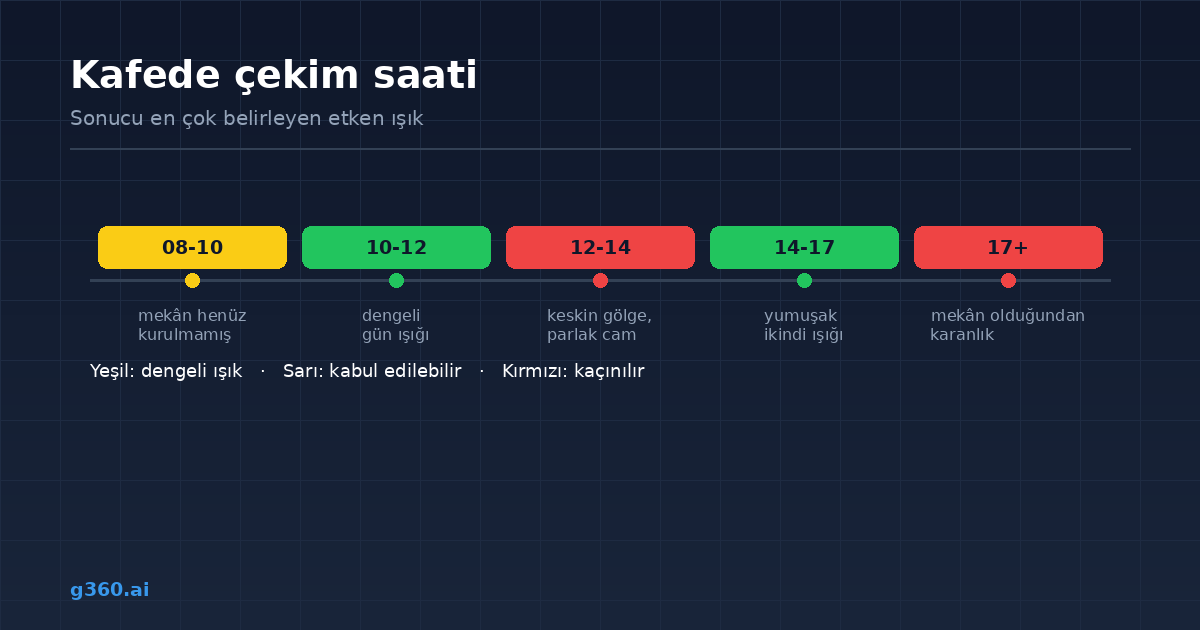
In a cafe shoot, light is the factor that shapes the result most.
In a cafe with natural light, midday creates harsh shadows, while late afternoon makes the venue look darker than it is. The most balanced results usually come between late morning and mid-afternoon.
Cafes with large windows have another problem: when it is much brighter outside than inside, the windows look like white patches. This can be balanced with shooting technique, but choosing the right time reduces it from the start.
Cafes lit by artificial light offer more flexibility on timing; the main thing there is that all lights are on and at the same color temperature.
Customers should not be in the frame
A shoot is possible while the cafe is open, but there should be no customers in the frame. There are two reasons: personal data and timelessness. A face that appears in the tour will still be there months later.
In practice, the cleanest solution is shooting before opening or after closing. The tables are set, the lights are on, the space is ready for service, but the room is empty.
The worry that an empty room will look cold is unfounded. Set tables, properly adjusted lighting, and a lived-in arrangement make the venue look alive.
Number of scenes
For a cafe with a single room, 4-6 scenes are usually enough. The measure is not square meters but the number of areas that look different from each other.
A garden, terrace, upper floor, or a separate work area each means an extra scene. A difference of a few meters between two tables does not require a separate scene.
The full calculation logic is in our virtual tour pricing guide.
What can be added inside the tour?
Common add-ons in cafe tours:
- Menu link: from a point in the tour to the digital menu
- Reservations: a link to the table booking page
- Instagram: a link to the venue's account
- Info note: opening hours, Wi-Fi, pet policy
These turn the tour from a showcase into a practical tool.
Does it work for small cafes?
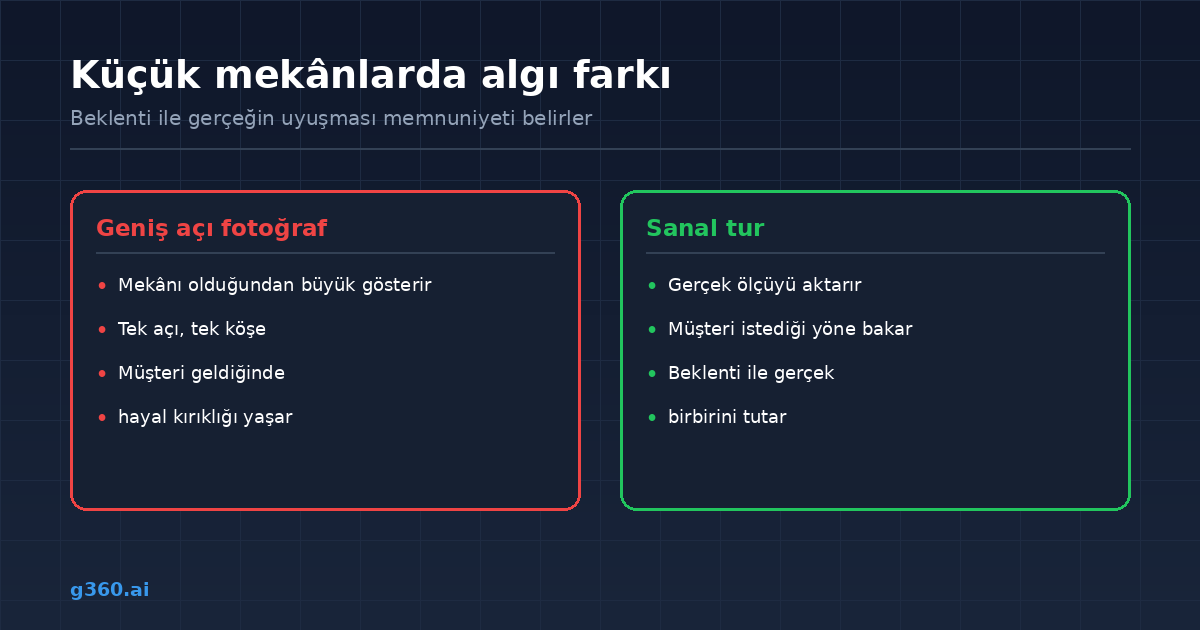
It does, even more than expected. Small venues tend to look cramped in photos; a wide-angle lens overcorrects for this, and customers are disappointed when they arrive.
A virtual tour conveys the real size of the space. That means expectations match reality, which removes one of the most common causes of dissatisfaction.
In short
What a cafe sells is not a drink but time spent there. A virtual tour shows in advance where and how that time will be spent.
You can browse our cafe portfolio and take a look at our restaurant virtual tour guide.
Frequently Asked Questions
Customers can choose where they will sit before they arrive. When options like a window seat, a work area, or the garden can be seen in advance, choosing a venue becomes easier.
Hours with the most balanced daylight are preferred. In cafes with natural light, late morning and mid-afternoon usually give the best results.
Yes, but customers should not appear in the frame. The most practical method is shooting before opening or after closing.
For a cafe with a single room, 4-6 scenes are enough. If there is a garden, upper floor, or separate work area, an extra scene is added for each.
Info points can be placed inside the tour to link to the menu, the reservation page, or social media accounts.
In small venues, a tour helps correct the impression that the space is cramped. A photo shows a single angle, while a tour conveys the real size of the venue.
The garden is a separate decision factor and is always shot. If the seasonal difference is noticeable, the tour can be updated at a different time of year.
No update is needed unless the concept or layout changes. It is refreshed after a renovation, new furniture, or the opening of a new area.
A Professional Virtual Tour for Your Business
Give your customers an unforgettable experience with a 360° virtual tour.
Get a Free Quote