Virtual Tour Companies in Turkey: Approaches and How to Choose
Virtual tour companies in Turkey work with three different technologies. Here is how they differ, which one fits which need, and the questions to ask when getting a quote.

Use the buttons below to get an AI summary of this article.
Virtual Tour Companies in Turkey: Approaches and How to Choose
The first problem a business owner runs into when looking for a virtual tour in Turkey is this: dozens of companies use almost the same sentences, yet the finished work looks wildly different from one to the next.
Most of the time, the difference does not come from the company itself but from the production approach it uses. There are three distinct technologies, each one answers a different need, and most of the price gap comes from this choice.
We prepared this guide as G360 and included ourselves in the list. It is not a ranking; it is a map of the approaches and of the specialties each company describes for itself. The information is based on what the companies state on their own websites and is accurate as of August 2026.
How the virtual tour market in Turkey is structured
The market is made up of three groups.
Companies focused on virtual tours. Teams whose core business is 360° production. They usually have their own equipment, their own processing workflows, and portfolios concentrated in specific industries.
Agencies that offer tours as a side service. Web design, social media, or advertising agencies that sell virtual tours as part of a package. They often outsource the shoot to another team.
Regional photographers. Usually one-person teams working in a single city or region. They can be an affordable option for small businesses.
All three are legitimate. But when you compare quotes, you need to know which one you are talking to, because after-sales support and long-term ownership of the tour work very differently across these groups.
Three different production approaches
The technology gap is the biggest reason for the price gap.
Google Street View-based production. Panoramas shot with a fisheye lens are stitched together and connected to Google Maps. The tour is hosted on Google's infrastructure and appears on the business listing as "See inside." Its strength is visibility: customers are already searching on Maps. Its weakness is limited flexibility in how the tour is structured.
Matterport-based production. Laser-assisted cameras capture a three-dimensional model of the space. Step-by-step navigation, measurements, and floor plans are all possible. It is strong in real estate and architecture. On the other hand, it usually requires a monthly or yearly hosting fee and does not connect to Maps directly; a separate Street View integration is needed.
Custom platforms (krpano and similar). The panoramas are loaded into a custom player. Scene transitions, side menus, info cards, presentation mode, and other storytelling features can be designed freely. It is the preferred choice for corporate projects and large facilities. It requires hosting.
In practice, most projects use a mix: Street View as the base layer, with extra features added on top as needed.

Questions to ask when getting a quote
The six questions above reveal the real difference between quotes. In our experience, these three cause the most surprises:
"Is there a yearly fee?" Tours published on Google Maps are hosted on Google's infrastructure, so they do not require a recurring fee. Matterport and custom platforms have a real server cost, and a fee there is reasonable, but it should be stated up front. A low starting price followed by a yearly fee later quietly pushes the total cost up.
"Whose account is the tour on?" Street View tours are published from a Google account. If that account belongs to the company and you part ways later, moving the tour can become a problem.
"What happens at the nadir?" The nadir is the bottom point of a 360° image, where the tripod stands. Some companies place their own logo there. That means another brand's logo sits in your business's tour for years. We cover this in detail in our nadir guide.
You can find the answers to the other three questions in our guide to choosing a virtual tour company.
Leading companies in Turkey
The list below is in alphabetical order and is not a ranking. Each company's description is based on what it states on its own website.
G360: Producing Google Street View-based tours since 2018, headquartered in Ankara. Its archive holds tours of 1,600+ businesses across Turkey, and it publishes the industry breakdown of this archive as open data. It works on hotels, restaurants, furniture showrooms, clinics, and special projects. This is the company that prepared this guide.
Mekandagez: Based in Istanbul, it says it has been producing panoramic content since the 2000s. It offers Matterport, 3D render-based virtual tours, and Google virtual tour services together. It has work in art and exhibition projects.
Sanalturcu: Puts Matterport technology front and center and also offers Street View integration. It focuses on real estate and business shoots.
Sanaltur360: Serves all of Turkey and publishes industry-specific pricing guides. It offers Street View and Matterport options together.
Tridi Medya: Works with a Matterport focus and states that it is a certified Google Street View Trusted photographer. It promises 24-48 hour delivery for hotel, showroom, factory, and real estate projects.
Beyond these, local photography studios in tourism-heavy regions such as Antalya, Muğla, and İzmir also produce 360° content. For small, single-location businesses, working with a regional team can save on travel costs.
If you think a company is missing from the list, you can write to bilgi@g360.ai; we review updates.
What drives the price range
Pricing in the industry works in one of two ways: by square meter or by scene (shooting point).
The scene-based approach gives more predictable results, because the cost is driven not by the size of the space but by the number of areas that need to be shot separately. An open 200-square-meter hall can be done in 5 scenes, while a partitioned clinic of the same size may need 12.
Other items that affect the price:
- Scope of image processing (whether HDR, scene-by-scene color balancing, and nadir cleanup are included)
- Whether Google Maps integration is included
- Hosting model and recurring fees
- Travel and accommodation for out-of-town projects
- Extra features such as info cards, menus, and presentation mode
We explain how the calculation works in our scene-based pricing guide.
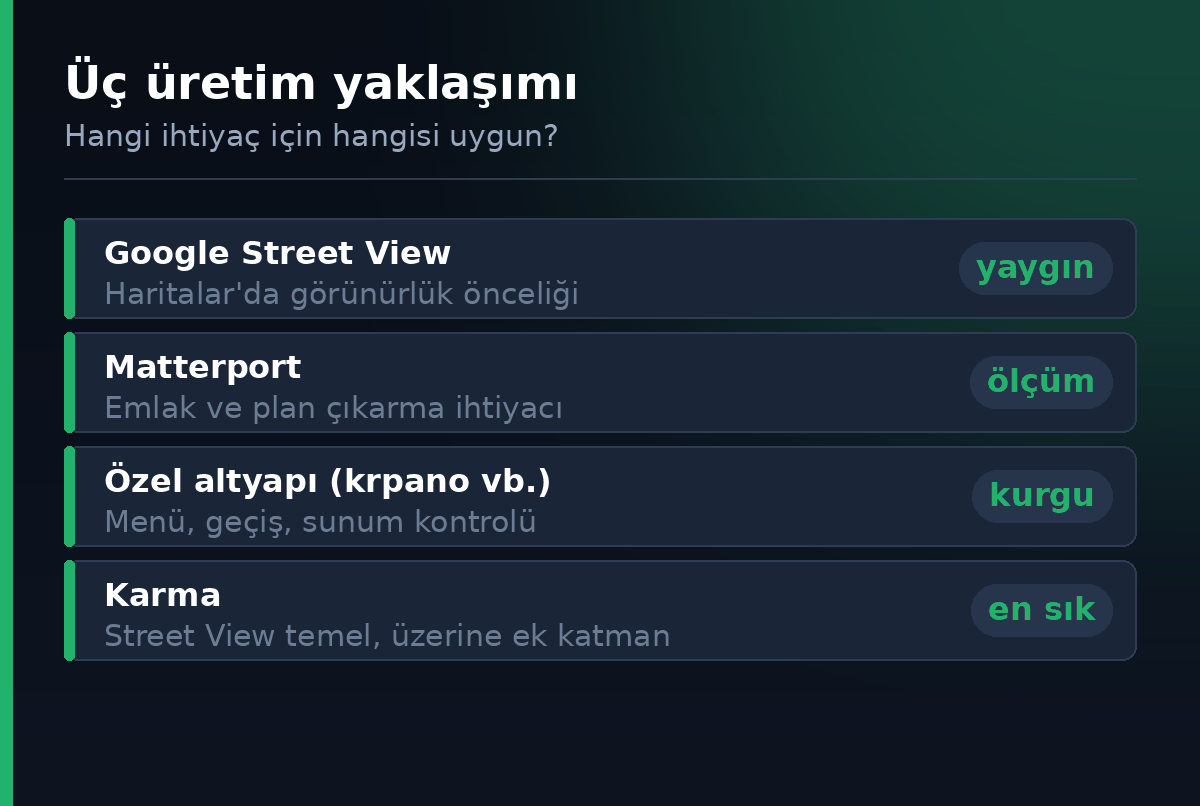
Comparing the approaches
The table above summarizes which need matches which approach. When deciding, it is enough to ask one question: what is the tour's main job?
If customers find you on Google and want to see the space, Street View-based production is the right choice; you do not need another layer. If you need to show a property remotely and let people take measurements, the extra capabilities Matterport brings justify the cost. If you need a corporate presentation, a custom menu, or a multi-section facility layout, a custom platform comes into play.
The most common mistake is choosing a solution with hosting fees when the need is at Street View level. We cover the Matterport vs. Street View comparison in a separate article.
Why we prepared this list
To be transparent: this guide was written by a virtual tour company that also put itself on the list.
Here is why we did it. When someone in Turkey searches for a virtual tour, all they find is advertising copy. There was no single resource explaining the difference between the approaches, what drives the price, and which questions to ask.
We tried not to tilt the list in our favor; we described our competitors as they are, in their own words. What makes a company right for you is not its marketing copy but its sample tour and how clear its quote is.
Summary
In the virtual tour market in Turkey, you are choosing an approach, not just a company. Street View for visibility, Matterport for measurements and remote property viewings, custom platforms for control over how the tour is built.
Whichever company you work with, ask the six questions: how many scenes, where will the tour be hosted, is there a recurring fee, what happens at the nadir, is image processing included, and whose account is the tour on.
If you want to know how many scenes your space needs, you can use the calculator on our pricing page.
Frequently Asked Questions
There are three main approaches: Google Street View-based production (focused on visibility on Maps), Matterport (laser-assisted 3D models, measurements, and floor plans), and custom platforms such as krpano (flexibility in structure and presentation). Most projects use a mix.
Street View tours are hosted on Google's infrastructure, appear on the business listing as "See inside," and usually do not require a recurring fee. Matterport creates a three-dimensional model with measurements and floor plans, but it usually comes with a monthly or yearly hosting fee.
Six questions: how many scenes will be shot, where will the tour be hosted, is there a recurring fee, what happens at the nadir, is image processing included in the price, and which account will the tour be published on. Any item without a clear answer can turn into a surprise cost later.
Tours published on Google Maps are hosted on Google's infrastructure, so they do not require a recurring fee. Matterport and custom platforms have a real server cost, so a fee there is reasonable, but it should be clearly stated at the start of the contract.
Two methods are common: by square meter or by number of scenes. The scene-based approach is more predictable, because the cost is driven by the number of areas that must be shot separately, not by floor area. Image processing scope, Maps integration, and out-of-town travel also affect the price.
For small, single-location businesses, it can save on travel costs. For chains, keeping quality and scope consistent across locations becomes harder; in that case, a team that works with a single scene template is the better choice.
It depends on which account the tour is published on. Street View tours are published from a Google account; if the account belongs to the company, moving the tour can be a problem. Clarify this point before signing a contract.
No. It is in alphabetical order and based on the information companies state on their own websites. The guide was prepared by G360, and G360 is included in the list. The information is accurate as of August 2026.
A Professional Virtual Tour for Your Business
Give your customers an unforgettable experience with a 360° virtual tour.
Get a Free Quote