What Is the Nadir? How to Remove the Tripod From a 360° Tour
There's a tripod under every 360° image. We explain the difference between covering it with a logo, blurring it and reconstructing the floor, and why one method is preferred.
Use the buttons below to get an AI summary of this article.
What Is the Nadir? How to Remove the Tripod From a 360° Tour
What do you see when you look down in a 360° image? The floor, and the tripod standing on it.
The lowest point of a panorama is called the nadir, and the highest point is the zenith. The nadir is a problem that has to be solved in every virtual tour, because the equipment used for the shoot inevitably stands right there.
What nadir means
Nadir is a term borrowed from astronomy: the point directly below the observer. The zenith is the point directly above.
In an equirectangular panorama, these two areas correspond to the bottom and top strips of the image. Because of the nature of the projection, these strips are heavily stretched. When the sphere is flattened, the poles spread out, just as Greenland looks bigger than it really is on a world map.
The practical consequence: a small area around the nadir corresponds to a wide strip in the panorama file, and every flaw there becomes noticeable.
Why the tripod is visible
Because the camera sits on top of the tripod, and the downward-facing frame records the tripod's legs and its shadow.
There's no way to avoid this entirely. Shooting without a tripod isn't an option; handheld shooting causes both camera shake and parallax.
Some shooting methods take the camera off the tripod for an extra frame, but that costs time in every scene and isn't practical on large projects. The standard approach is to accept the tripod and clean it up afterward.
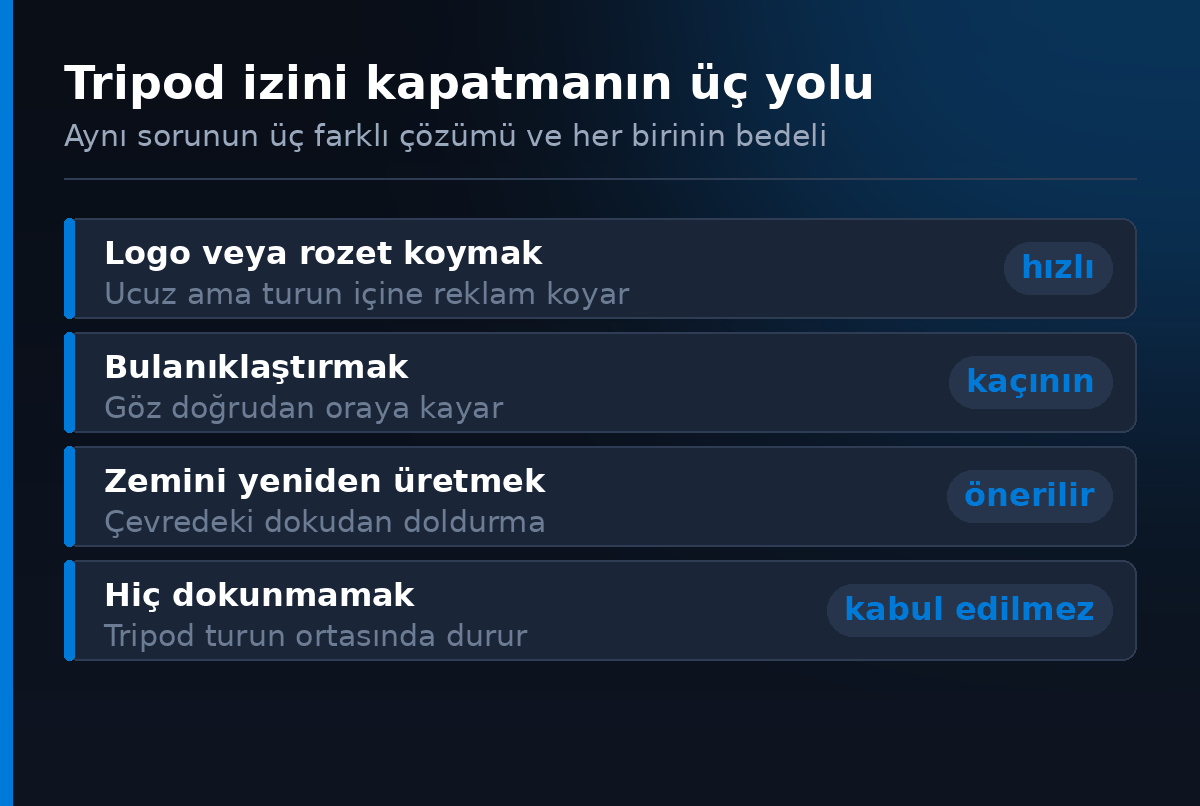
Three ways to hide the tripod mark
The methods used in the industry, and the cost of each, are summarized above. The difference between them matters more to a business than it might seem.
Placing a logo or badge is the quickest way. A circular logo is placed over the nadir area and the tripod is completely covered. The problem: a graphic element now sits inside the tour, and it's often the logo of the company that did the shoot. In the business's own space, in the business's own tour, another brand's logo is on display.
Blurring is the worst option. The eye naturally drifts toward areas that aren't sharp; a blurry circle draws more attention than the tripod itself.
Reconstructing the floor is the right method. The area where the tripod stood is rebuilt using the surrounding floor texture. When it's done well, visitors don't realize anything was ever there.
Is placing a logo a good idea?
The answer depends on the situation.
The business's own logo can be used, and sometimes it's preferred; in corporate tours especially, having the brand at the bottom point can be a deliberate choice.
The logo of the company that did the shoot is another matter. It means placing a permanent ad in the business's online presence. The tour stays online for years, and that logo sits there for the whole time.
The clear question to ask when getting a quote is: what will be in the nadir? If the answer is "our logo," you need to decide up front whether that's acceptable. Changing it later means reprocessing.
How the floor texture is reconstructed
Roughly, the process works like this: the nadir area is first converted into a flat image (from spherical projection to a plane), the area covered by the tripod is marked, that area is filled in using the surrounding texture, and the result is put back into spherical projection.
How well the fill works depends on the floor. Regular, predictable textures such as plain concrete, wall-to-wall carpet and single-color tiles are easy to reproduce. Complex, irregular patterns are hard, because the software has to work out where the pattern would continue.
In recent years, AI-based fill methods have been used for this, and they give good results on plain floors. On difficult surfaces such as patterned carpet, manual work may still be needed.
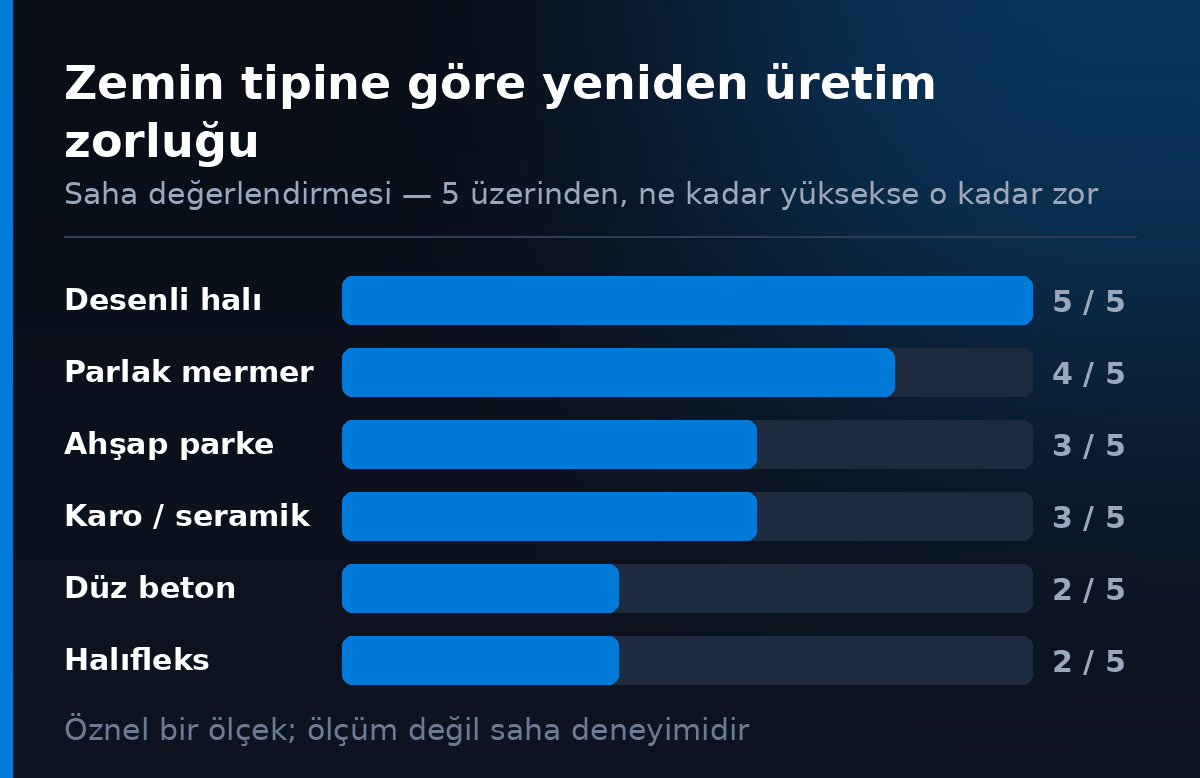
Difficulty by floor type
The scale above is a subjective assessment based on field experience, not a measurement.
What it means in practice: in a venue with patterned carpet, nadir work takes longer. Hotel lobbies, wedding halls and some restaurants fall into this group.
There's also something the business can do: a clean floor before the shoot makes this work easier. If there are stains, cables or small items around the tripod, the fill algorithm tries to repeat them as well, and the result suffers.
Ask about it when getting a quote
Nadir quality is an indicator that gives you a quick sense of a tour's overall production quality. When reviewing a sample tour:
- Look down. Does the floor continue, or is there a blurry circle?
- Is there a logo? If so, whose logo is it?
- Is the texture consistent? Does the carpet pattern continue naturally, or does it break off into a blurry patch?
- Check more than one scene. It isn't enough for one scene to look good; has the same care been taken in every scene?
This check takes a minute, and it's one of the most practical tests when choosing a company.
Summary
The nadir is a small but visible detail of a virtual tour. Even if visitors don't consciously look at it, a blurry circle or someone else's logo at the bottom point lowers the overall impression of the tour.
The right approach is to reconstruct the floor; placing a logo is only defensible if it's the business's own logo, and blurring is not a solution.
We've listed what should be included as standard in a tour in our pricing guide; nadir cleanup is part of the image processing item.
Frequently Asked Questions
In a 360° panorama, it is the point directly below the observer, meaning the very bottom of the image. The point directly above is called the zenith. Because these two areas are heavily stretched in equirectangular projection, flaws there are very noticeable.
The camera sits on top of the tripod, so the downward-facing frame records the tripod's legs and shadow. Shooting without a tripod causes shake and parallax, so it isn't practical; the standard approach is to accept the tripod and clean it up afterward.
There are three methods: placing a logo or badge over the nadir, blurring the area, or reconstructing it from the surrounding floor texture. The third is the right one; when it's done well, visitors can't tell anything was changed.
The business's own logo is a matter of preference and can be used deliberately in corporate tours. The logo of the company that did the shoot, however, means placing a permanent ad in the business's online presence. Ask what will be in the nadir when you get a quote.
The eye naturally drifts toward areas that aren't sharp. A blurry circle draws more attention than the tripod it is trying to hide, and it becomes the first place where the tour looks low quality.
Patterned carpet is the hardest surface, because the software has to work out where the pattern would continue. Glossy marble is difficult because of reflections. Plain concrete, wall-to-wall carpet and single-color tiles are easy to reproduce.
A clean floor makes the work easier. If there are stains, cables or small items around the tripod, the fill process tries to repeat them too, and the result suffers.
Look down: does the floor continue naturally, is there a blurry circle, and if there's a logo, whose is it? Check whether the carpet pattern continues naturally, and look at several scenes, not just one, to see whether the same care was taken throughout.
A Professional Virtual Tour for Your Business
Give your customers an unforgettable experience with a 360° virtual tour.
Get a Free Quote