HDR in 360° Photography: When Do You Need It, and When Does It Hurt?
In a space with windows, HDR is unavoidable. But overdo it and the space looks unreal. Exposure brackets, the moving object problem and getting the balance right.
Use the buttons below to get an AI summary of this article.
HDR in 360° Photography: When Do You Need It, and When Does It Hurt?
Every interior shoot runs into the same problem: expose for the window and the room stays dark; expose for the room and the window blows out to pure white. Your eyes can see both at once, but the camera cannot.
HDR (high dynamic range) exists to close that gap. In 360° photography it becomes almost mandatory, because a single scene looks at both the window and the dark corner at the same time.
What HDR means
Dynamic range is the difference between the darkest and the brightest point in an image. The human eye perceives this difference across a wide band; a camera sensor works within a narrower band.
HDR is a method in which the same scene is captured at different exposures and merged into a single image. The detail in the window is taken from the dark exposure, the detail in the shadowy corner from the bright exposure, and the two are combined.
The result is an image closer to what your eyes see. The goal is not to make the image prettier but to get past the limits of the sensor.
Why it is unavoidable in 360°
In normal photography you can choose your frame. If a window causes trouble, you leave it out.
In 360° photography there is no such option. By definition the scene looks in every direction: the same image contains both a sunlit glass facade and a corridor that gets no light. A 360° scene shot with a single exposure will always show part of the space incorrectly.
That is why HDR is not an option in professional virtual tour production but a standard. In G360's production method, every scene is processed this way.
How exposure bracketing works
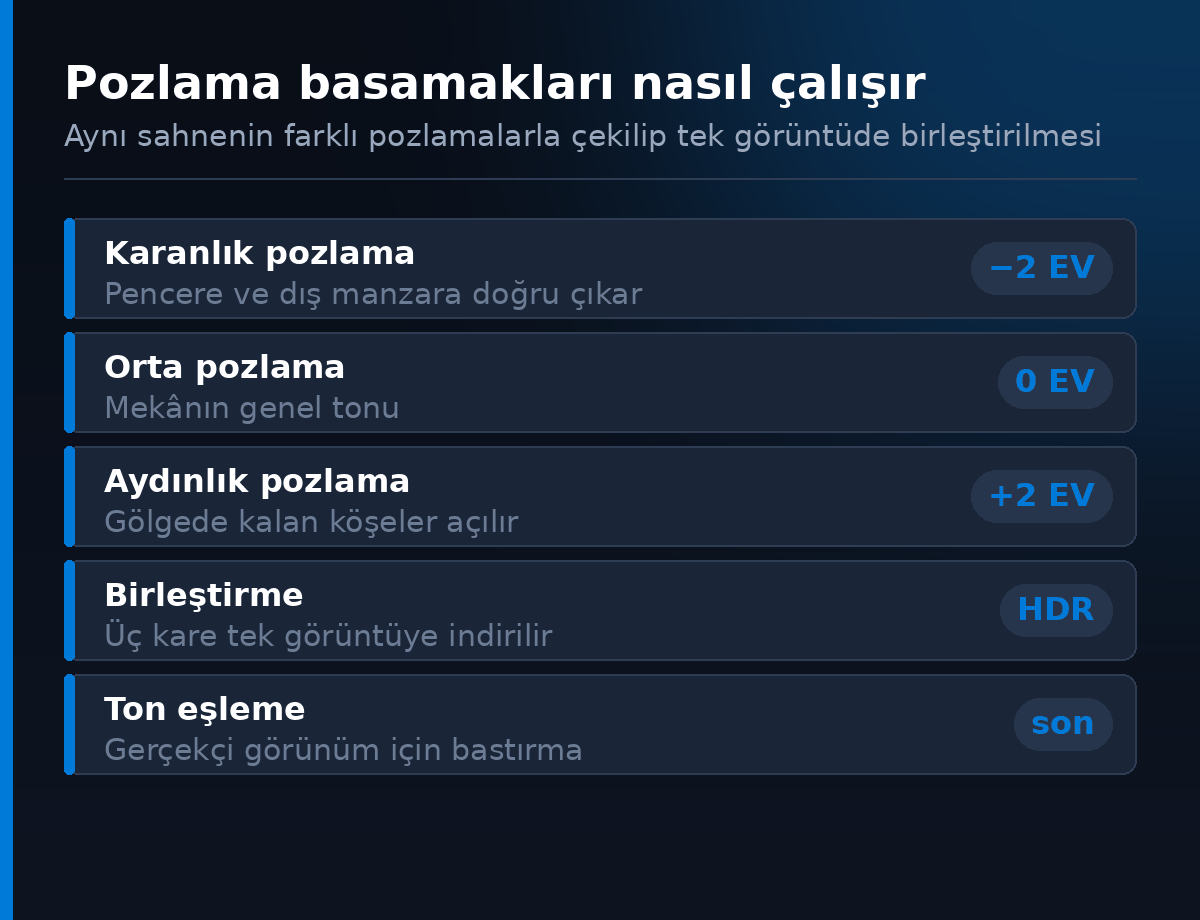
In practice, the camera takes frames from the same point at three or five different exposures. The brackets are expressed in EV (exposure value).
How many brackets you need depends on the contrast in the space. In a storage room with no windows, three brackets are more than enough. A showroom with a glass facade may need five, or even seven.
Adding more brackets has a cost: the shoot takes longer, the risk of moving objects goes up and the file size grows. So the rule is not "the more the better"; the decision depends on the space.
How to spot overdone HDR
Bad HDR looks worse than no HDR at all. The signs are familiar:
- No shadows. Everything is equally bright, and there is no depth anywhere
- Halos around objects. A light-colored outline forms around the edge of a dark piece of furniture
- Unrealistic saturation. Colors are exaggerated, and the wall paint looks more vivid than it is
- Gray sky. In an exterior scene the sky comes out leaden gray instead of blue
All of these come from pushing the tone mapping stage too hard. The right measure is this: when people look at the image, they should not notice that HDR was used. If they notice, it has gone too far.
This is a practical problem for a business. A tour that shows the space differently from how it really is creates a mismatch in expectations when the customer arrives.
The moving object problem
HDR has a built-in weakness: the brackets are not captured at the same time but one after another. If something moves in the frame during those few seconds, that object ends up in a different place in different frames.
The result is a ghost image when the frames are merged. A person walking appears semi-transparent in two places; a swaying curtain leaves a blurry band.
How we deal with this on site:
- The shoot is done whenever possible while the space is empty or closed
- Air conditioners and fans are switched off during the shoot
- If a window is open, the curtain is secured
- Outdoors, windy weather and peak traffic hours are avoided
When it cannot be avoided, the area with movement is taken from a single exposure and merged in. That area stays slightly darker or brighter, but no ghost image appears.
From our archive: spaces with mixed lighting
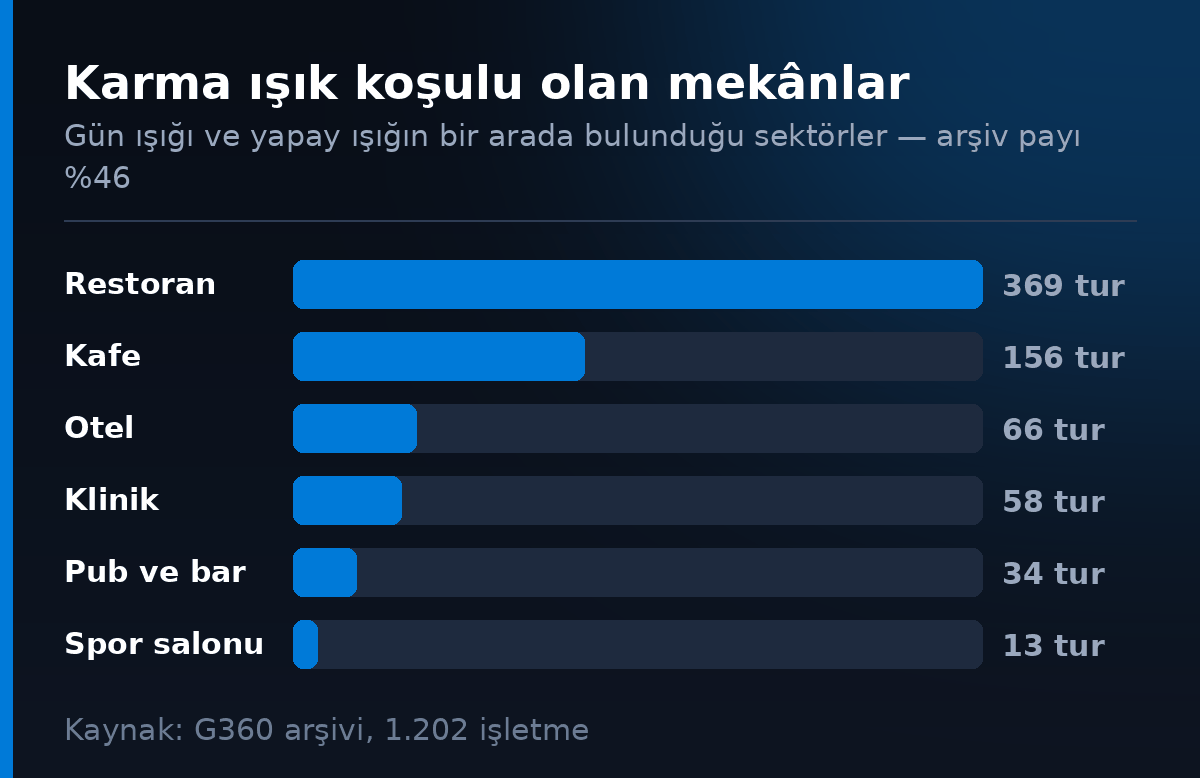
HDR matters most in spaces where daylight and artificial light coexist. In these conditions there is not only a difference in brightness but also a difference in color temperature: light from the window leans blue, while ceiling lighting is yellow.
When we split the 1,600+ businesses in the G360 archive this way, restaurants, cafés, hotels, clinics, pubs and gyms add up to 888 projects, roughly 58% of the archive. In other words, three out of every five projects are in a space that needs scene-by-scene color balancing on top of HDR.
We cover this topic from the angle of shooting times and space preparation in a separate guide. You can find the shooting approach for these industries in our hotel and café guides, and the full breakdown of the archive in the data report.
When HDR is not needed
Not every scene needs HDR. In these conditions a single exposure is enough and gives a cleaner result:
- Windowless interiors with uniform lighting (storage rooms, corridors, basements)
- Exterior scenes shot in overcast weather
- Areas with constant movement that cannot be stopped; here HDR does more harm than good
These decisions are made on site; a single setting is not applied to the whole project. Within one tour, some scenes can be processed with HDR and others with a single exposure.
Summary
HDR is an essential technique in 360° photography for getting past the camera's limits. When it is applied correctly, visitors do not notice it; they see the space as they would with their own eyes.
When it is applied badly, it makes the space look unreal and undermines the tour's real job: building trust. When you ask for a quote, checking the color of the sky and the halos around furniture edges in a sample tour gives you a quick idea of how a provider handles this.
We explain why image processing should be included in the price in our pricing guide.
Frequently Asked Questions
It means capturing the same scene at different exposures and merging them into a single image. The window detail is taken from the dark exposure and the detail in the shadowy corner from the bright exposure. The goal is not to make the image prettier but to get past the sensor's dynamic range limit.
In practice, yes. In normal photography you can choose your frame and leave a problem window out; a 360° scene by definition looks in every direction. A 360° scene shot with a single exposure will always show part of the space incorrectly.
It depends on the contrast in the space. Three brackets are enough in a windowless storage room; a showroom with a glass facade may need five, sometimes seven. More brackets mean a longer shoot and a higher risk of moving objects.
Typical signs are a space that looks shadowless and evenly lit, light-colored halos around the edges of dark objects, exaggerated color saturation and a leaden gray sky in exterior shots. HDR that is applied correctly goes unnoticed.
Not when it is applied correctly, but it does when it is overdone. A tour that shows the space differently from how it really is creates a mismatch in expectations when the customer arrives and weakens the tour's main purpose.
Because the brackets are captured one after another, a moving object ends up in a different place in different frames and a ghost image appears. That is why the shoot is done while the space is empty, air conditioners and fans are switched off and curtains are secured.
No. In windowless interiors with uniform lighting, in exterior scenes shot in overcast weather and in areas with constant movement, a single exposure gives a cleaner result. The decision is made scene by scene.
In spaces where daylight and artificial light coexist. In the G360 archive, restaurants, cafés, hotels, clinics, pubs and gyms add up to 888 projects, roughly 58% of the archive; these spaces need scene-by-scene color balancing as well as HDR.
A Professional Virtual Tour for Your Business
Give your customers an unforgettable experience with a 360° virtual tour.
Get a Free Quote