How Is Virtual Tour Pricing Calculated? A Guide to Scene-Based Pricing
Virtual tour pricing is based on the number of scenes, not square meters. Learn what a scene is, how many scenes different businesses need, and what to check when getting a quote, using the pricing logic behind 1,600+ projects.

Use the buttons below to get an AI summary of this article.
How Is Virtual Tour Pricing Calculated?
Ask most companies what a virtual tour costs and you will hear the same answer: "We need to see the space first." That answer is true, but it is incomplete. Once you understand how the price is calculated, you can judge the quotes you receive and plan your budget in advance.
In this guide, we explain the exact pricing logic we have used at more than 1,600 businesses since 2018.
The short answer: scenes, not square meters
The most common misconception about virtual tour pricing is that the price depends on the size of the space. In reality, the deciding factor is the number of scenes.
Picture a single open hall of 400 square meters next to a 150-square-meter clinic with six rooms. The first is far larger on paper, yet the second is more work for a virtual tour. The price is set not by floor area but by how many separate points need to be shot.
What is a scene?
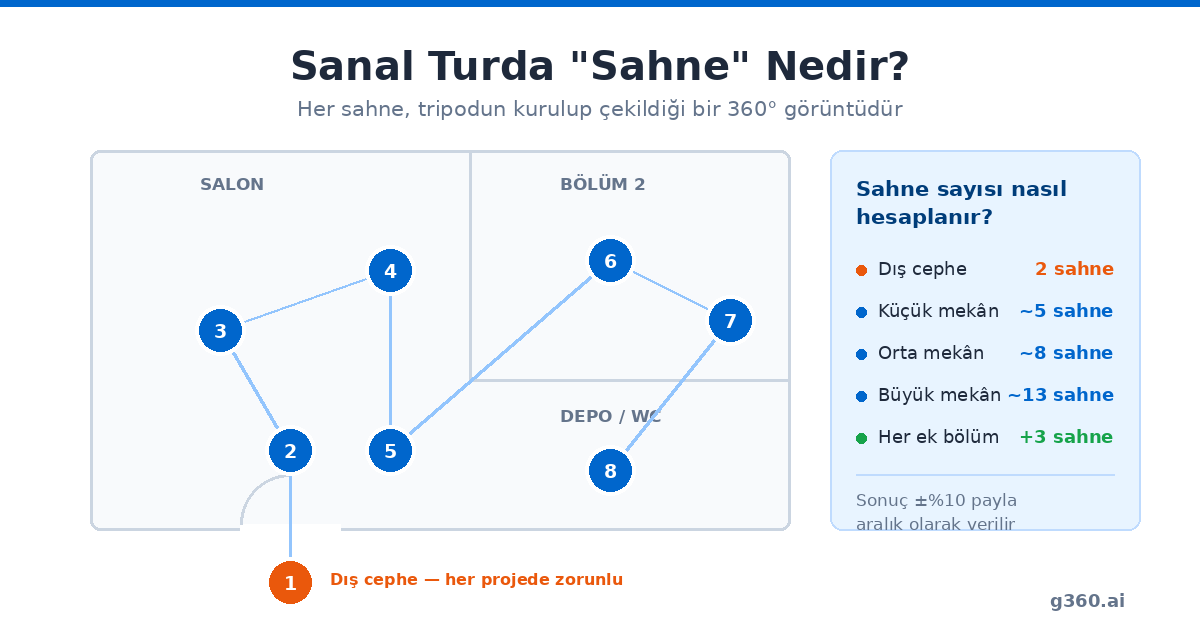
A scene is a single 360° image captured from one spot where the tripod is set up in your space. As visitors move through the virtual tour, they click the arrows on the floor to jump from one scene to the next.
In other words, a virtual tour is a network of connected scenes. More scenes mean more time on site, more images to process, more work building the transitions between scenes, and a longer upload process to Google Maps. That is why the scene is the natural pricing unit for this kind of work.
How many scenes do you need?
The scene count is made up of three parts.
1. Exterior: fixed on every project
The exterior and signage are shot on every project, so you do not need to request them. The reason is technical: for the virtual tour on Google Maps to connect with the Street View imagery on the street, the entrance point has to be captured. Otherwise, the tour sits disconnected on the map.
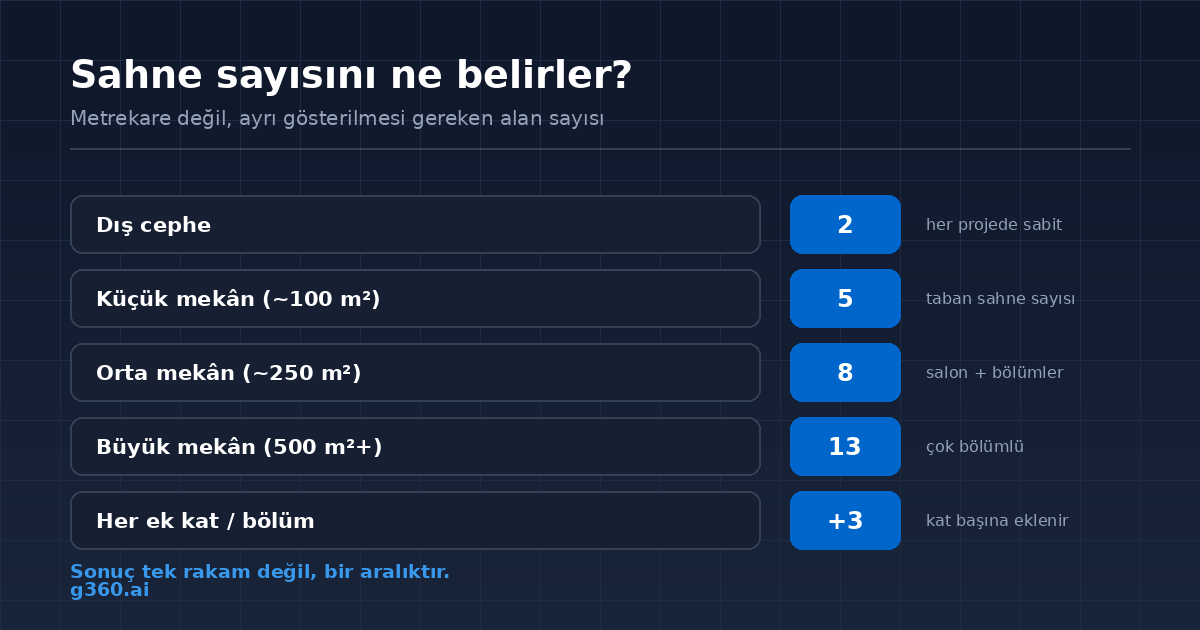
The exterior usually accounts for 2 scenes.
2. Size of the space: the base scene count
Businesses fall roughly into three groups:
| Size | Description | Base scenes |
|---|---|---|
| Small | Single area (jeweler, stationery shop, small cafe) | ~5 scenes |
| Medium | Several areas (restaurant, clinic, store) | ~8 scenes |
| Large | Many areas or multiple floors (showroom, facility) | ~13 scenes |
These figures are base values and exclude the exterior.
3. Extra sections and floors
For businesses with more than one section, roughly 3 scenes are added for each extra section or floor after the first.
Take a two-floor restaurant as an example: a dining room downstairs and a family section upstairs. That is 8 base scenes, plus 3 scenes for the extra section and 2 scenes for the exterior, for a total of about 13 scenes.
The result is a range, not a single number
The calculated scene count is given as a range with a margin of about 10%. So instead of "13 scenes," the estimate is "12–14 scenes."
This is a deliberate choice. Once you are inside a space, something unexpected always turns up: a back garden nobody mentioned, a section thought to be closed, or the opposite, a planned area that turns out to be unsuitable for shooting. Giving a range is more honest than giving a fixed number.
Why are hotels calculated differently?
Hotels are structurally different from other businesses when it comes to virtual tours. In a restaurant, the sections are clear. In a hotel, room types, shared areas, and amenities are all intertwined.
Every room type, not every room
This is the question hotel owners ask most often: "I have 80 rooms. Will you shoot all of them?"
No. The goal of a virtual tour is not to take inventory but to show guests what to expect. That is why one example of each room type is shot. If you have three room types (standard, family, suite), three rooms are shot, not 80.
Amenities drive the scene count
In a hotel, the shared areas are what really set the count. Each of the following needs its own scene or group of scenes: breakfast room, restaurant, pool (indoor and outdoor count separately), spa and hammam, fitness room, ballrooms and wedding halls, bar, terrace and garden, beach or pier, kids' club, parking lot, and meeting rooms.
The lobby and reception are shot at every hotel anyway and are not counted separately.
That is why a boutique hotel can be completed with 15–20 scenes, while a fully equipped resort can go beyond 40 scenes.
Other factors that affect the price
The scene count is the main driver, but it is not the only variable.
Location. If the team has to travel out of town, transport and, when needed, accommodation are reflected in the price. This is the most common reason two projects with the same scene count are priced differently. When several shoots can be scheduled in the same city on the same day, that cost is shared, which is why companies that work heavily in one city can usually offer better quotes.
Urgency. Projects that must be delivered by a specific date outside the standard delivery time need scheduling priority.
Additional services. Services such as drone aerial footage, promotional videos, and product photography are separate from the virtual tour and priced on their own.
Access conditions. If the shoot has to happen while the business is closed, planning changes.
What should the price include?
This is the most important point when comparing quotes. When two quotes cover the same number of scenes, the difference between them usually comes down to scope.
A sound virtual tour quote should include:
- On-site shoot, with professional 360° equipment
- Image processing, including stitching, color correction, and tripod removal
- Linking the scenes together, by placing the navigation arrows
- Publishing on Google Maps
- Connecting to your Google Business Profile
- Embed code for your website
- Revision rights
If any of these items is missing, the total cost goes up even when the price looks low. For example, a tour that is not integrated with Google Maps is just a file sitting on your website. It misses the biggest benefit of a virtual tour: visibility on maps.
7 questions to ask when getting a quote
Whichever company you work with, ask these questions:
- How many scenes will be shot? "The whole space" is not a good enough answer, so ask for a number.
- Is the exterior included?
- Is publishing on Google Maps included, or is it an extra charge?
- Will the tour be connected to my Google Business Profile?
- Can I embed it on my website, and do I get the code?
- How many revisions do I get?
- Is it a one-time payment, or is there an annual hosting fee?
The last question matters most. Some companies quote a low starting price and then charge an annual hosting fee. Tours published on Google Maps are hosted on Google's infrastructure, so there should be no need for that kind of fee.
Three common mistakes
"I'll just take the cheapest quote." With a virtual tour, the product is the quality of the delivered imagery. A low-resolution, badly stitched, dark tour makes your business look worse than it is, and that can do more harm than having no tour at all.
"We'll expand it later." A virtual tour is a single whole. Adding scenes later means the team has to come back and match the earlier lighting conditions. Getting the scope right from the start is more cost-effective.
Not asking for references. Ask to see tours the company has already shot, and say that you want examples from your own industry. Shooting a jewelry store and shooting a hotel are not the same job.
Estimate your own scene count
If you want to know how many scenes you need, you can use the calculator on our pricing page. Find your business on Google, answer a few questions, and you will see the estimated scene range for your space.
You can explore the industry and city breakdown of the projects we have completed across Turkey in our data report.
Frequently Asked Questions
Virtual tour pricing is based on the number of scenes, not the square footage of the space. A scene is a single 360° image captured from one spot where the tripod is set up. The scene count is the sum of the exterior, the size of the space, and any extra sections. Location, urgency, and additional services also affect the price.
A scene is a single 360-degree image captured from one spot where the tripod is set up in your space. Visitors move from one scene to the next by clicking the arrows on the floor as they explore the virtual tour. A virtual tour is made up of connected scenes.
For small businesses with a single area, the base is about 5 scenes. The 2 exterior scenes shot on every project are added to that. The exact count is confirmed on site and given as a range with a margin of about 10%.
No. In hotels, one example of each room type is shot, not every room. If you have three room types, three rooms are shot. What really drives the scene count in a hotel is the shared areas, such as the breakfast room, restaurant, pool, spa, fitness room, ballrooms, terrace, and meeting rooms.
No. A single 400-square-meter hall can need fewer scenes than a 150-square-meter clinic with six rooms. What matters is not the floor area but how many separate points need to be shot.
No. The exterior and signage are shot as standard on every project. This is a technical requirement: the entrance point has to be captured so the virtual tour can connect with the street imagery on Google Maps.
A sound quote should include the on-site shoot, image processing, linking the scenes together, publishing on Google Maps, connecting to your Google Business Profile, embed code for your website, and revision rights. If any of these is missing, the total cost goes up.
Tours published on Google Maps are hosted on Google's infrastructure, so there should be no need for an annual hosting fee. When getting a quote, make it clear whether it is a one-time payment or a recurring fee.
The most common reason is location. If the team has to travel out of town, transport and accommodation costs are reflected in the price. Urgency, access conditions, and additional services such as drone footage can also make a difference.
It is technically possible but not cost-effective. Adding scenes later means the team has to come back and match the lighting conditions of the earlier shoot. Getting the scope right from the start is more affordable.
A Professional Virtual Tour for Your Business
Give your customers an unforgettable experience with a 360° virtual tour.
Get a Free Quote