360° Virtual Tour Equipment: Camera, Lens, and Tripod
Why is a professional 360° shooting kit still built around a camera body and a fisheye lens? What does a panoramic head do, and can you shoot a tour with a phone?
Use the buttons below to get an AI summary of this article.
360° Virtual Tour Equipment: Camera, Lens, and Tripod
The short answer to the virtual tour equipment question is this: it is not a single device but a set of tools that work together.
There are small cameras on the market that shoot 360° at the press of a button, and they are good enough for many jobs. But when it comes to producing a tour that meets the Google Street View quality bar, the equipment still follows the classic route: a camera body, a fisheye lens, and a properly set-up tripod.
Three classes of equipment
Devices that produce 360° images fall roughly into three groups.
Phone panoramas. A spherical image made by turning the phone around. Because rotating by hand creates parallax, stitching errors are unavoidable, and detail falls apart in low light.
Consumer 360° cameras. Small devices with two fisheye lenses that shoot at the press of a button. They are fast and practical, and good enough for social media and personal use. Indoors and in low light, noise becomes noticeable, and the stitch line between the two lenses is visible.
Camera body + fisheye lens kit. The standard for professional virtual tour production. It is slow but controlled. Because the sensor is large, images stay clean in low light, and HDR brackets can be adjusted flexibly.
Which class to choose depends on where the tour will be published. For a tour that will be connected to Google Maps, the quality bar is clear.
Why fisheye + camera body still wins
Consumer cameras get better every year, but they have not replaced professional kits in professional production. There are three reasons.
Sensor size. Interior shoots are often done in low light. A small sensor produces noise in these conditions, and noise makes matching harder during stitching.
Exposure control. In a professional kit, every bracket can be set manually. In a consumer camera, an automatic algorithm makes the call, and in spaces with mixed lighting it often makes the wrong one.
Number of stitches. A two-lens camera has a single stitch line, and that line is fixed. If it lands in a bad spot, it cannot be moved. With multi-shot capture, the stitch lines can be planned so they fall on areas that are easy to match rather than on featureless surfaces.
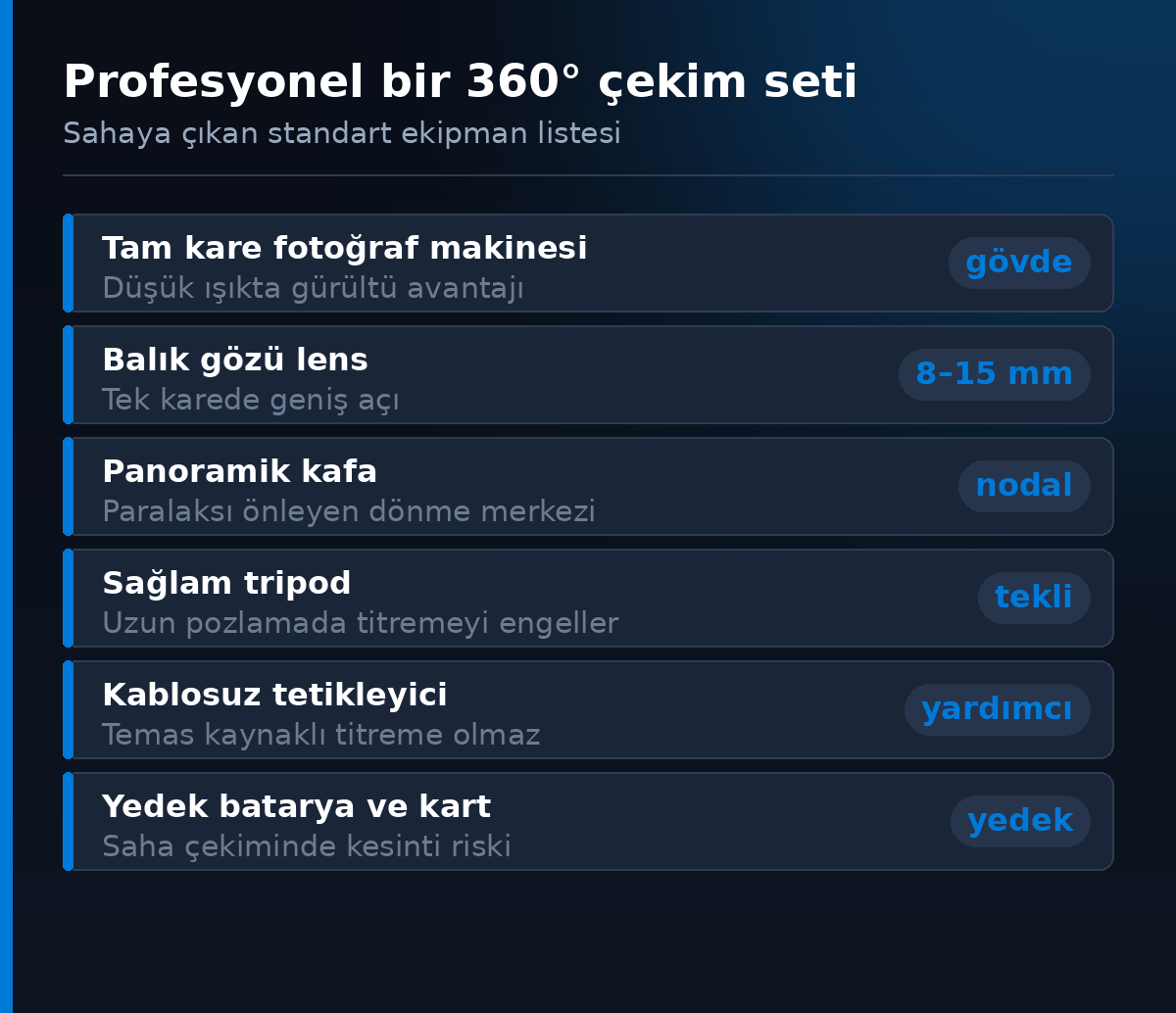
A professional shooting kit
The standard kit we take on site is shown above. Every item on the list solves a specific problem; none of it is for show.
The most overlooked item is the panoramic head. We cover it separately in the next section, because it is usually the most decisive and the cheapest part of the kit.
Spare batteries and memory cards are on the list too. An interruption on site means a second trip to the business, which adds cost and brings different lighting conditions.
Panoramic head and nodal point
When you rotate a camera on a tripod, the center of rotation is normally where the tripod screw is. But the image is formed at the optical center of the lens, which is called the nodal point.
When the two do not line up, near objects shift against far objects as the camera rotates. That is parallax, and the result is broken lines when the images are stitched.
A panoramic head is a mechanical part that rotates the camera around the nodal point. Its job is that simple, and its impact is that big. A properly adjusted head does more to determine stitching quality than the software does.
It is also worth adding that the setting is specific to each lens. Every lens has its nodal point in a different place, so the head is calibrated separately for each lens.
Tripod and vibration
A tripod has two jobs: keeping the height constant and preventing vibration.
Height is set to eye level, around 150–160 cm. Below that, the space looks bigger than it is; above it, smaller. If the height changes within the same tour, visitors feel a jump when moving between scenes, which is one of the clearest signs of an amateur tour.
Vibration becomes a problem in low light. The longer the exposure, the more even the smallest movement causes blur. That is why a sturdy tripod and a wireless trigger are used; even touching the camera by hand creates enough vibration to matter.
The tripod itself also stays in the image, at the bottom point. We explain how it is removed in a separate guide.
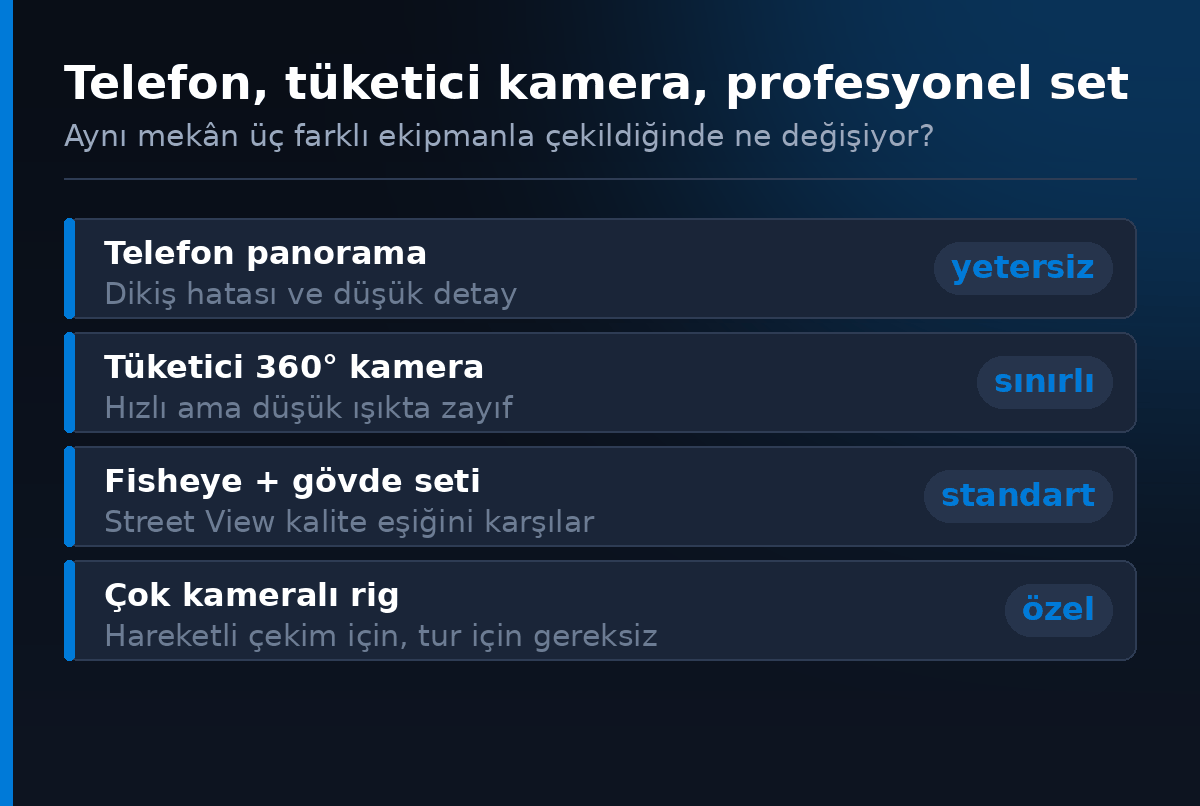
Phone vs. consumer camera vs. professional kit
The comparison above sums up the practical results we see on site.
The takeaway is not that "expensive equipment makes a good tour." Equipment is a necessary condition but not a sufficient one. An expensive kit that is set up badly gives worse results than a mid-range kit that is set up properly.
For business owners, the practical takeaway is this: asking for a sample tour tells you more than asking about the equipment brand. In our guide to choosing a virtual tour company, we list what to look for in a sample tour.
How equipment differences show up in a quote
Equipment is not the only reason quotes differ, but it is one of the visible ones.
Shooting with a professional kit takes longer than shooting with a consumer camera. At every scene, the tripod is set up and leveled, and several frames are taken at several exposures. The difference in time spent on site can be two to three times.
That difference feeds directly into scene-based pricing. If there is a big gap between two quotes for the same space, the question to ask is usually not "what equipment?" but "how many scenes, and what processing is included?"
Summary
360° tour equipment is a set of tools that work together: a large-sensor camera body, a fisheye lens, a panoramic head that rotates around the nodal point, and a sturdy tripod.
The most critical and least known part of the kit is the panoramic head; it shapes stitching quality more than the software does. The most common mistake is changing the tripod height between scenes.
You can find the full process in our guide on how to get a virtual tour made.
Frequently Asked Questions
The standard kit is a large-sensor camera body, a fisheye lens, a panoramic head, a sturdy tripod, a wireless trigger, and spare batteries and memory cards. Each piece solves a specific technical problem.
It rotates the camera around the optical center of the lens (the nodal point) instead of the tripod screw. This keeps near and far objects from shifting against each other and prevents breaks caused by parallax. It is one of the most decisive parts of the kit.
Technically, a phone can produce a 360° image, but not at professional tour quality. Rotating by hand creates parallax, stitching errors appear, and detail falls apart in low light. It is not good enough for tours that will be connected to Google Maps.
They are good enough for social media and personal use. There are three reasons they are not preferred for professional production: the small sensor produces noise in low light, automatic exposure makes wrong calls in mixed lighting, and the fixed stitch line cannot be moved.
The height is set to eye level, around 150–160 cm. Lower, the space looks bigger than it is; higher, it looks smaller. If the height changes within the same tour, the transitions between scenes feel like a jump.
It is the optical center of the lens, where the image is formed. When the camera is not rotated around this point, parallax occurs. Because every lens has its nodal point in a different place, the panoramic head is calibrated separately for each lens.
No. Equipment is a necessary condition but not a sufficient one. An expensive kit that is set up badly gives worse results than a mid-range kit that is set up properly. Asking for a sample tour tells you more than asking about the equipment brand.
Shooting with a professional kit takes longer: at every scene, the tripod is set up and leveled, and several frames are taken at several exposures. The time spent on site can be two to three times longer, and this is reflected in scene-based pricing.
A Professional Virtual Tour for Your Business
Give your customers an unforgettable experience with a 360° virtual tour.
Get a Free Quote