How Are 360° Photos Stitched? A Guide to Stitching
Why do stitching seams appear, what is parallax, and which errors can be fixed afterward? The journey of a 360° panorama from raw frames to a published scene.

Use the buttons below to get an AI summary of this article.
How Are 360° Photos Stitched? A Guide to Stitching
Every scene you see in a virtual tour is not actually a single photo. It's made by merging several frames shot in different directions from the same point. This merging process is called stitching, and it is the single most important technical stage in determining the quality of a tour.
When it's done well, nobody notices it. When it's done badly, visitors can't put a name to the problem, but they sense something is wrong.
What stitching means
A camera can only see a certain angle in a single frame. To get a 360-degree spherical image, the camera is rotated around a fixed center, several frames are shot, and software fits those frames onto the surface of a sphere.
The resulting file is called an equirectangular panorama. It looks like a world map: the sphere has been unrolled into a two-dimensional rectangle. The tour player wraps this file back around a sphere, and you turn around inside it.
In other words, stitching squeezes a three-dimensional space into a single two-dimensional file. As with any compression, there's a margin for error.
Why stitching seams appear
The frames overlap at their edges, and in this overlap zone the software has to match common details. When matching fails, these symptoms appear:
- Broken lines. A straight table edge, door frame or floor joint shifts along the seam
- Warped surfaces. A flat wall ripples slightly
- Ghosting. The same object appears twice, semi-transparent
- Tonal differences. A visible light-dark boundary forms in the overlap zone
These symptoms don't all come from the same source. The first two are usually shooting errors, the third is movement and the fourth is a difference in exposure.

The stitching process step by step
The process has six stages, and something different can go wrong at each one.
The most critical stage is the second: control point matching. The software looks for common details between neighboring frames, such as a power outlet, the corner of a painting or a floor pattern. Surfaces with little detail (a bare white wall, a single-color carpet, plain glass) make this stage harder, because there's nothing to match.
That's why an empty corridor is technically harder than a living room full of furniture.
Parallax: the most common mistake
Parallax is by far the most common cause of stitching problems, and it happens entirely during the shoot.
If the center of rotation isn't at the optical center of the lens when the camera is turned, nearby and distant objects shift relative to each other. It's the same thing that happens when you look out of a window and move your head left and right: the window frame shifts against the view behind it.
The result: the distant wall stitches cleanly, but the edge of the table near the tripod splits in two.
The fix is a piece of equipment called a panoramic head. It rotates the camera around the nodal point of the lens, so near and far objects don't shift relative to each other. We cover this piece separately in our equipment guide.
Parallax can't be fixed afterward. The only fix for a badly set up shoot is to shoot it again.
Which errors can be fixed and which can't
This distinction is worth knowing when you evaluate a quote.
Fixable afterward: tonal and color differences between frames, slight exposure drift, the tripod mark in the nadir (the point directly below the camera), small-scale ghosting, and the gap at the zenith (the point directly overhead).
Not fixable: breaks caused by parallax, blur that happened during the shoot, a moving object appearing in different places in two frames, and gaps caused by insufficient overlap.
An approach that says "we'll handle it in processing" for an error in the second group means, in practice, blurring or cropping that area. And that's what you'll see in the tour.
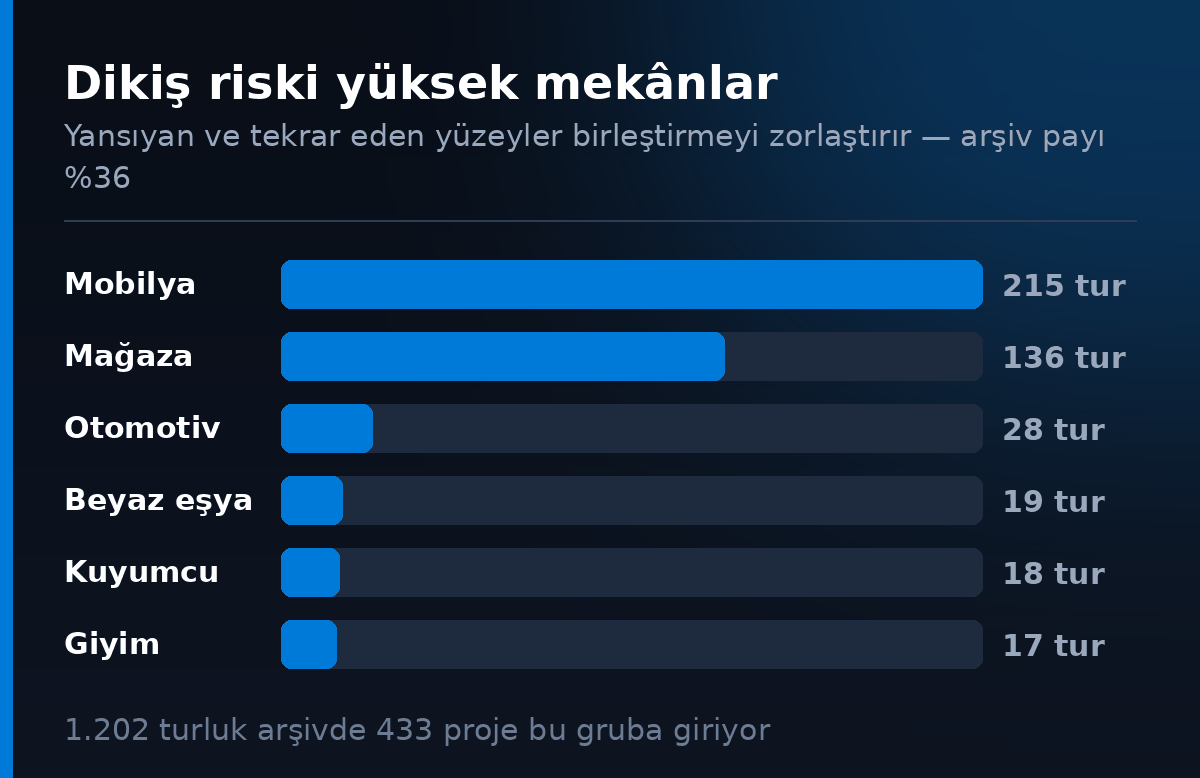
From our archive: venues with a high stitching risk
Two types of surface make stitching harder: reflective surfaces and repeating patterns. On a reflective surface, each frame sees a different reflection, so the detail to be matched changes from frame to frame. With a repeating pattern, the software gets confused about which repetition matches which.
When we sorted the 1,600+ businesses in the G360 archive this way, 487 projects (32%) fell into this group: furniture stores, retail stores, car dealerships, home appliance dealers, jewelers and clothing stores.
In other words, a third of the archive consists of venues that aren't technically "easy." In these industries, the shooting method and tripod positioning are planned differently from a standard office shoot, and managing reflections is a topic of its own.
You can find the full industry breakdown of the archive in our Turkey data report, and our shooting approach for these industries in the furniture store and retail store guides.
Three things to ask when getting a quote
You can't judge stitching quality from a price list. But you can judge it from a sample tour. As we explain in our guide to choosing a company, ask for a sample tour and check these:
- Look at the floor. Is the spot where the tripod stood clean, or is there a blurry circle or a logo?
- Look for straight lines. Door frames, table edges, ceiling joints: do they break?
- Look up. Is the top of the ceiling cleanly closed, or is there a blurry smudge?
These three are the quickest test of stitching quality, and they need no technical knowledge.
Summary
Stitching is the invisible but decisive stage of virtual tour production. When it's done well, visitors explore the space; when it's done badly, they wrestle with the image itself.
The key point: most of the stitching quality is decided at the moment of shooting, not in processing. Without the right equipment, the right center of rotation and enough overlap, no software can rescue the result.
You can read how the whole process works in our how to get a virtual tour made guide.
Frequently Asked Questions
It's the process of merging photos shot in different directions from the same point into a single 360° spherical image. The resulting file is called an equirectangular panorama; the tour player wraps it around a sphere so it can be explored.
The frames overlap at their edges, and the software has to match common details in that zone. When matching fails, you get broken lines, warped surfaces, ghosting or visible tonal differences.
If the center of rotation isn't at the optical center of the lens when the camera is turned, near and far objects shift relative to each other. The distant wall stitches cleanly, but objects close to the tripod split in two. A panoramic head prevents it.
No. Parallax happens during the shoot and can't be removed with software. The only fix for a badly set up shoot is to go back to the venue and shoot it again.
Tonal and color differences between frames, slight exposure drift, the tripod mark in the nadir, small-scale ghosting and the gap at the zenith can be fixed. Parallax, focus problems and insufficient overlap can't.
Usually not. The software looks for common details to match frames. Featureless surfaces such as a bare white wall, a single-color carpet or plain glass make matching harder. A furnished living room is technically easier to stitch.
Check three things: whether the spot where the tripod stood is clean or shows a blurry circle or logo; whether straight lines such as door frames and table edges break; and whether the top of the ceiling is cleanly closed.
Reflective surfaces and repeating patterns make stitching harder. Of the 1,600+ businesses in the G360 archive, 487 (32%) fall into this group: furniture, retail stores, automotive, home appliances, jewelers and clothing.
A Professional Virtual Tour for Your Business
Give your customers an unforgettable experience with a 360° virtual tour.
Get a Free Quote