A Virtual Tour Guide for Clinics and Medical Practices
What do patients look at most when choosing a clinic? Rules on hygiene, privacy and trust drawn from shoots at 53 healthcare facilities.

Use the buttons below to get an AI summary of this article.
A Virtual Tour Guide for Clinics and Medical Practices
In healthcare, decisions are not made by looking at a price list. Before walking into a clinic, patients wonder: is it clean, is the waiting area crowded, what does the examination room look like? The answers to these questions are not in the text on a website but in the space itself.
Our archive includes 53 clinics and healthcare facilities in 16 provinces and 27 districts. This group's average Google rating is 4.73, one of the highest averages in our portfolio. 33 of the clinics have a rating of 4.5 or higher. In other words, patient satisfaction is already high; what is missing is showing that satisfaction to patients who are still deciding.
What do patients look at?
A pattern repeats in our clinic shoots: when visitors open the tour, they first look at the waiting area, then at the examination room. Reception comes third.
The reason is simple. The waiting area shows how long and in what conditions the patient will be sitting. The examination room is at the center of their real concern: is the equipment new, is the room tidy, will I feel comfortable here?
That is why we order the scenes in clinic tours along the patient journey: entrance → waiting area → examination room → imaging unit, if there is one. Visitors move through it as if they had actually come to the clinic.
Which areas are photographed and which are not
Photographed:
- Entrance and reception
- Waiting area
- Examination and treatment rooms
- Imaging, laboratory and sterilization units
- Private rooms or comfort areas, if any
Not photographed:
- The archive where patient files are kept
- Staff rooms and break areas
- Any spot with a computer whose screen is on
- Boards, files or labels showing names, dates or identity details
This distinction is not optional. Keeping personal data out of the frame is a precondition for the shoot.
Privacy: the pre-shoot checklist
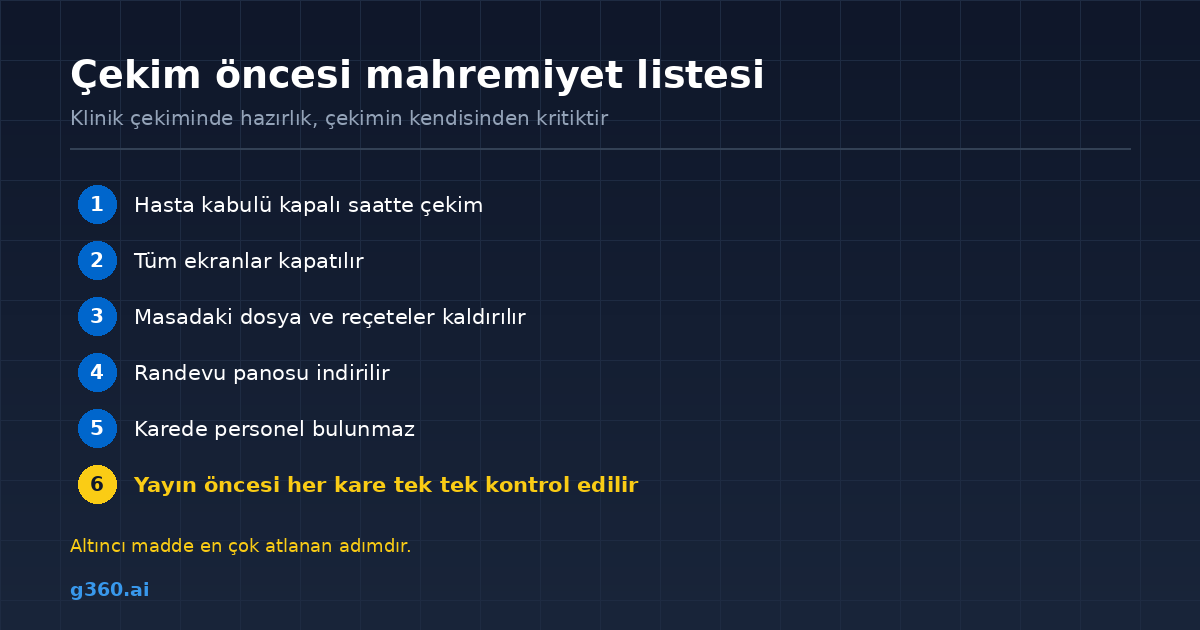
Clinic shoots differ from other industries in one respect: the preparation is more critical than the shoot itself.
- The shoot is done during hours when patient admissions are closed
- All screens are turned off or locked
- Files, prescriptions and labels on desks are removed
- Patient lists and appointment boards on the walls are taken down
- No staff are in the frame
- After the shoot, every frame is reviewed one by one
The sixth step is the one most often skipped. Before publishing, every scene is checked for readable text; if any is found, that frame is reshot.
Show the sterilization area
In dental clinics and centers that perform surgical procedures, the most frequently asked question is about hygiene. It is hard to answer that question in writing; a tidy scene of the sterilization unit settles it before it is even asked.
Among the clinics in our archive, those that include the sterilization area in the tour are the group where patient hesitation is lowest. In most clinics this area is already clean and orderly; it is just not visible.
How many scenes should there be?
For a single-floor medical practice, 4-8 scenes are usually enough: the entrance, the waiting area, one or two examination rooms and the corridor.
In a multi-department outpatient clinic, the number grows with each department. The measure here is not floor area but the number of distinct functional areas. If two examination rooms are identical, photographing both only makes the tour longer.
For more on how scenes work, see our virtual tour pricing guide.
Where should you use the tour?
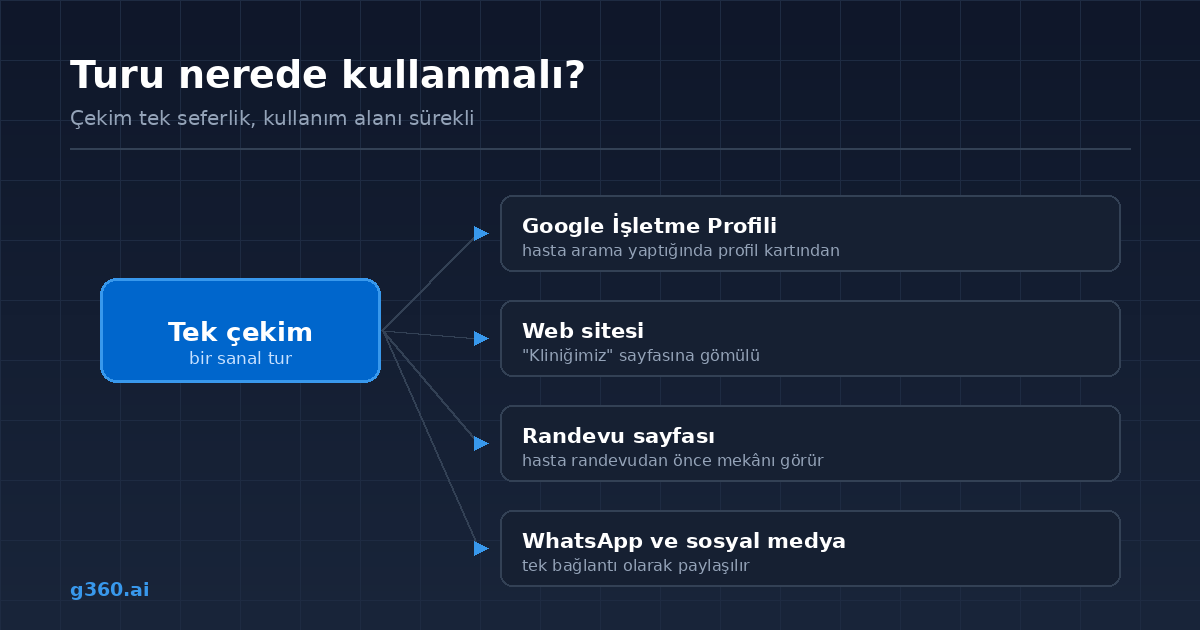
The shoot is a one-time job; the uses are many:
- Google Business Profile: it opens from the profile card when patients search for the clinic
- Website: embedded on the "Our Clinic" page
- Appointment page: patients see the space before booking an appointment
- WhatsApp and social media: shared as a single link
We explain how the Google integration works in our article on showing the inside of your business on Google Maps.
In summary
A clinic virtual tour is less a promotional asset than an answer to the questions patients ask before they walk through the door. For a clinic with high patient satisfaction, it means making the quality that already exists visible.
You can explore our healthcare work in our clinic portfolio.
Frequently Asked Questions
The entrance, reception, waiting area, examination rooms and, if there is one, the imaging or laboratory unit. Areas with patient files, staff rooms and the archive are left out.
The shoot is done during hours when patient admissions are closed. No patients, staff or documents with identity details appear in the frame. Screens are turned off, and files and labels with names on them are removed.
No problem arises as long as no personal data or identifiable people appear in the frame. That is why turning off screens and removing documents before the shoot is standard practice.
The examination room is the area patients are most curious about. Even a single scene in which the equipment and room look orderly noticeably reduces hesitation.
4-8 scenes are usually enough for a single-floor medical practice. In multi-department outpatient clinics, the number grows with each department.
For a mid-sized clinic, the shoot takes a few hours. If a time outside appointments is chosen, there is no need to pause service.
It appears on your Google Business Profile and on Google Maps, next to the business photos. It can be opened directly from the profile card in search results.
In dental clinics, the treatment rooms and the sterilization area stand out. Making the sterilization unit visible answers the hygiene question patients ask most often before they even ask it.
A Professional Virtual Tour for Your Business
Give your customers an unforgettable experience with a 360° virtual tour.
Get a Free Quote