Virtual Tours for Jewelers: Balancing Trust and Security
For a jeweler, a virtual tour means balancing two goals: showing the display cases and protecting security. Rules drawn from 28 jeweler shoots.

Use the buttons below to get an AI summary of this article.
Virtual Tours for Jewelers: Balancing Trust and Security
Jewelry is one of the industries where a virtual tour has to be planned most carefully. The reason is clear: two things are wanted at the same time. Showing the space to customers, and protecting security.
These two seem to conflict, but they do not. When the right line is drawn, the tour does its job without giving up anything on security.
Our archive includes 28 jewelers in Ankara, Bolu, Tekirdağ, Antalya, and İstanbul. The group's average Google rating is 4.51, clearly above our retail average. When jewelry customers are satisfied, they write about it; the problem is the hesitation before they come to the store.
Why do customers hesitate?
Buying jewelry is a high-value purchase that people make rarely. The customer usually:
- Will be visiting the store for the first time
- Will come with a spouse, family, or fiancé
- Does not know how long they will stay or what kind of environment to expect
This uncertainty steers customers toward a store they already know. A virtual tour removes this uncertainty for first-time customers.
Especially when shopping for an engagement or a wedding, couples look through the store together from home first. When they come to their appointment, the decision process is much shorter.
Areas that are never shot
In a jeweler shoot, the list of limits comes before the list of what to shoot:
- The safe and the area around it: from no angle and at no distance
- Security system panels and alarm units
- Camera positions and monitoring screens
- Back office, storeroom, and counting area
- Staff entry and exit points and access-control doors
This list is not up for discussion. The only thing a jeweler tour should show is the area customers would see anyway when they walk in.
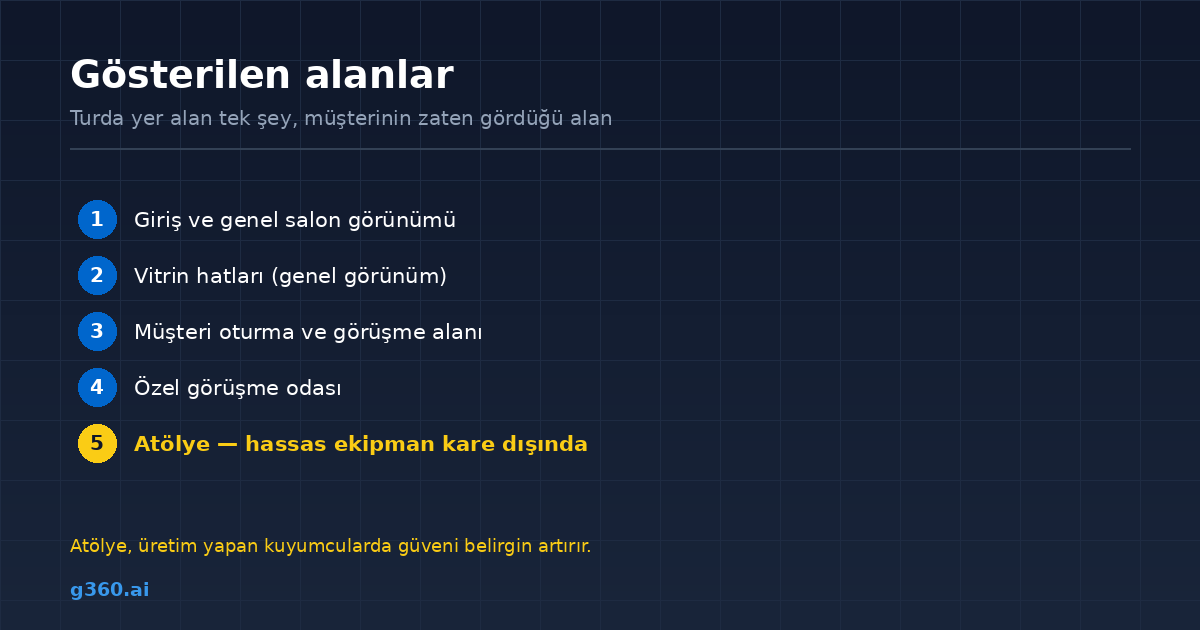
Areas that are shown
- The entrance and a general view of the showroom
- Display case lines (as a general view)
- Customer seating and consultation area
- A private consultation room, if there is one
- A workshop, if there is one, with sensitive equipment kept out of the frame
How are display cases shown?
The common misunderstanding here is this: a jeweler tour is not a product catalog.
Display cases appear in a way that gives a general view and a sense of range, not so that each item can be examined. In the tour, customers are not asking "what is the price of that ring?"; they are checking "do they have the style I am looking for?"
This approach also has a practical advantage: the tour does not become outdated when the contents of the display cases change.
Jewelers with a workshop
For jewelers who make their own pieces, including the workshop in the tour clearly increases trust. Customers see where the piece is made.
But there is a limit here too: the workbench and the general work area are visible, while storage points for valuable materials and sensitive equipment stay out of the frame.
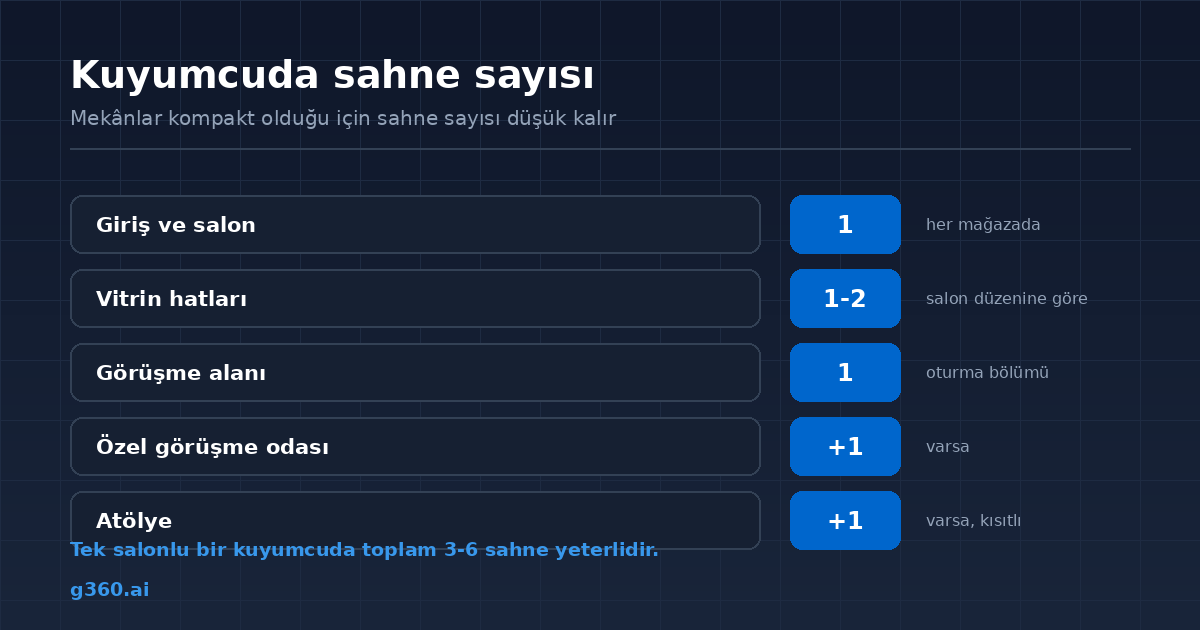
Number of scenes
For a jeweler with a single showroom, 3-6 scenes is usually enough. Since these venues are mostly compact, the scene count stays low.
If there is a separate consultation room, an upper floor, or a workshop, an extra scene is added for each. The calculation logic is in our virtual tour pricing guide.
Where should you use the tour?
- Google Business Profile: when customers search for "jeweler"
- Website: on the page that introduces the store
- WhatsApp: as a link sent to customers before their appointment
- Social media: in the profile link
The third item works especially well for jewelers: when the tour link is sent to customers while setting up an appointment, they arrive already familiar with the space.
In short
For a jeweler, a virtual tour is not a security gap; when planned correctly, it is a tool for building trust. When the list of limits is kept clear, the store becomes visible and nothing sensitive is shown.
You can browse our jeweler portfolio.
Frequently Asked Questions
There is no risk when the safe, security equipment, camera positions, and back office are left out of the shoot. The tour only includes areas open to customers.
The safe and the area around it, security system panels, camera positions, the back office, the storeroom, and entry and exit control points.
Display cases appear as a general view. The goal is not to show each item in readable detail; the focus is on the space and a sense of range.
For high-value purchases, customers want to get to know the store in advance. Seeing the tour reduces the hesitation before the first visit.
For a jeweler with a single showroom, 3-6 scenes is usually enough. The number goes up if there is a separate consultation room or a workshop.
For jewelers who make their own pieces, showing the workshop increases trust. However, for security reasons, sensitive equipment is kept out of the frame.
No update is needed unless the display layout or the store layout changes.
Couples can look through the store together before visiting. This shortens the decision process before the appointment.
A Professional Virtual Tour for Your Business
Give your customers an unforgettable experience with a 360° virtual tour.
Get a Free Quote