How Do Virtual Tours Contribute to SEO?
A virtual tour won't lift your rankings on its own. But when it is set up correctly, it makes a measurable difference in local search, click-through rate and time on page.
Use the buttons below to get an AI summary of this article.
How Do Virtual Tours Contribute to SEO?
There are two extreme takes on this in the industry. One says "a virtual tour sends your SEO through the roof", the other says "it has no effect at all". Neither is true.
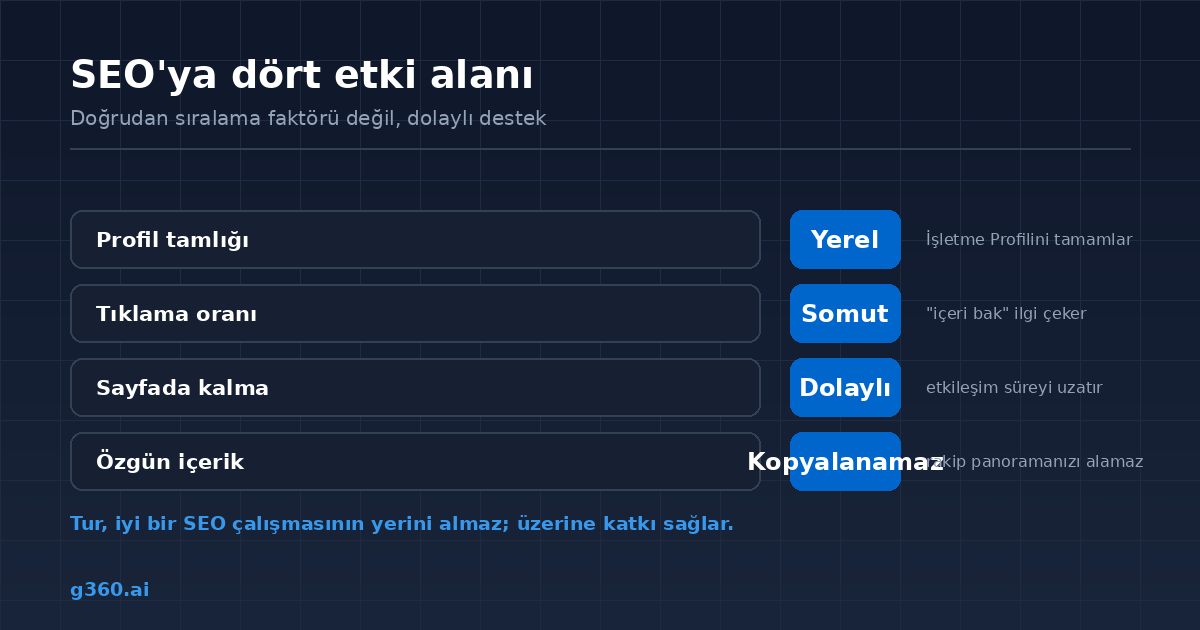
The truth is this: a virtual tour is not a direct ranking factor. But it makes a difference in four measurable areas, and all of these areas are connected to rankings.
1. Profile completeness in local search
The Google Business Profile is the main structure that determines rankings in local search. Google takes into account how complete a profile is: category, opening hours, photos, reviews, services.
A virtual tour is one of the components that completes the visual side of a profile. On its own it is not decisive, but like any component that is left out, its absence is noticeable.
For all 1,600+ businesses in our archive, the tour was published connected to the Business Profile. The average Google rating of these businesses is 4.28, and 509 of them are rated above 4.5.
2. Click-through rate
This is the area where the most tangible effect can be seen.
When two businesses appear side by side in search results, and one has only photos while the other has a "See Inside" option, the second one attracts more attention. Users get curious and click.
Click-through rate is one of the behavioral signals Google tracks. A result that consistently gets more clicks holds or strengthens its position over time.
3. Time on page
Visitors who land on a page with an embedded virtual tour stay longer than visitors who only read text. That is because exploring a tour is interactive: visitors drag, turn around and click on hotspots.
A long visit is an indirect sign that the page gave users the answer they were looking for. On its own, this does not earn rankings, but it works in the opposite direction to quick exits (bounces).
The way to increase time spent in the tour runs through hotspots; we explain the details in our hotspots and info cards guide.
4. Structured data and content context
Adding structured data with your business information to the page that hosts the tour makes it easier for search engines to interpret the page correctly: which business, which city, which service.
This is not a contribution of the virtual tour itself, but it adds value to the page the tour sits on. The tour adds an original layer of content that cannot be copied: a competitor can copy the same text, but they cannot copy the panorama of your space.
Common misconceptions
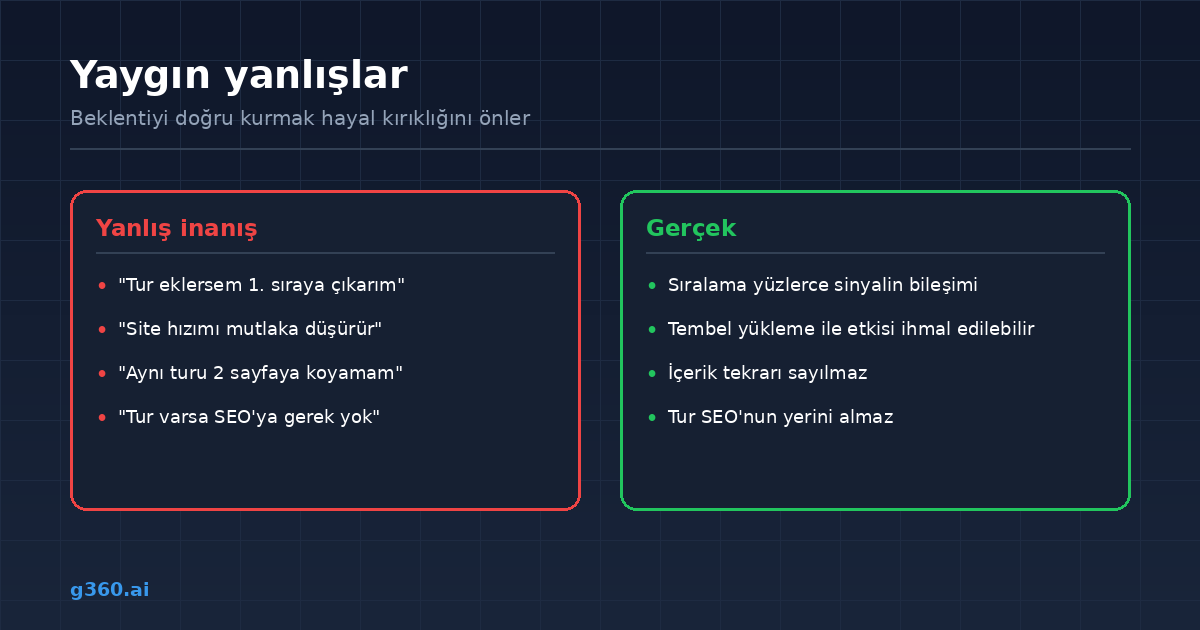
"If I add a virtual tour, I'll rank first." You won't. Rankings are a combination of relevance, distance, prominence and hundreds of other signals. A tour supports only a few of them.
"Putting the tour on my site will lower my speed score." It will if lazy loading is not used. When the tour is embedded correctly, the effect is negligible. We explain the method in our guide on embedding a virtual tour on your website.
"If I put the same tour on more than one page, it will count as duplicate content." It won't. The tour is a frame loaded from a separate source, not page text.
"If I have a virtual tour, I don't need SEO." You still do. A tour adds to good SEO work; it does not replace it.
When will you see results?
Changes in local visibility are usually noticeable within a few weeks; as the profile is updated, it takes time for Google to re-evaluate it.
The ranking effect, however, cannot be measured in isolation. It becomes meaningful when the virtual tour works together with review management, the right category choice, up-to-date information and regular posts.
In summary
A virtual tour is not a ranking trick but a component that completes your profile and improves user behavior. If you set your expectations correctly, you won't be disappointed.
We share where our archive stands in numbers in our virtual tour statistics article.
Frequently Asked Questions
It is not a direct ranking factor. But it increases profile completeness in local search, raises click-through rate and extends time on page, and these have an indirect effect.
Whether a Google Business Profile is complete is taken into account in local rankings. A virtual tour is one of the components that completes the visual side of the profile.
In search results, a business card with a 'See Inside' option attracts more attention than a card with only photos. This increases click-through rate.
Visitors stay on the page longer while they explore the tour. A long visit is an indirect sign that the page gave them the answer they were looking for.
Adding structured data with your business information to the page that hosts the tour is helpful. It makes it easier for search engines to interpret the page correctly.
No. The same tour can be embedded on different pages; this does not count as duplicate content because the tour is loaded from a separate source.
It can if lazy loading is not used. When the tour is embedded correctly, its effect on page load speed is negligible.
Changes in local visibility are usually noticeable within a few weeks. The ranking effect should be assessed together with your other SEO work.
A Professional Virtual Tour for Your Business
Give your customers an unforgettable experience with a 360° virtual tour.
Get a Free Quote