What Is 3D Gaussian Splatting? Is It the Future of Virtual Tours?
A new 3D visualization method is getting a lot of attention. What does it actually do, will it replace virtual tours, and can businesses use it today?
Use the buttons below to get an AI summary of this article.
What Is 3D Gaussian Splatting? Is It the Future of Virtual Tours?
Lately, the most talked-about topic in 3D visualization has been 3D Gaussian Splatting (3DGS for short). The demo videos are genuinely impressive: light, reflections and depth look very realistic.
But will it change virtual tours for businesses? Let's take an impartial look.
How does it work?
Classic 3D modeling represents a scene with a surface mesh made of triangles. Gaussian Splatting doesn't.
Instead, it represents the scene with millions of tiny, translucent, colored points. Each point has a specific position, color, transparency and a brightness that changes depending on the viewing direction. When these points overlap, they form an image that looks realistic to the eye.
The key difference: the method doesn't try to extract a surface; it represents the appearance directly. That's why it performs noticeably better where classic methods struggle, such as glass, water, polished surfaces and reflections.
How it differs from photogrammetry and panoramas
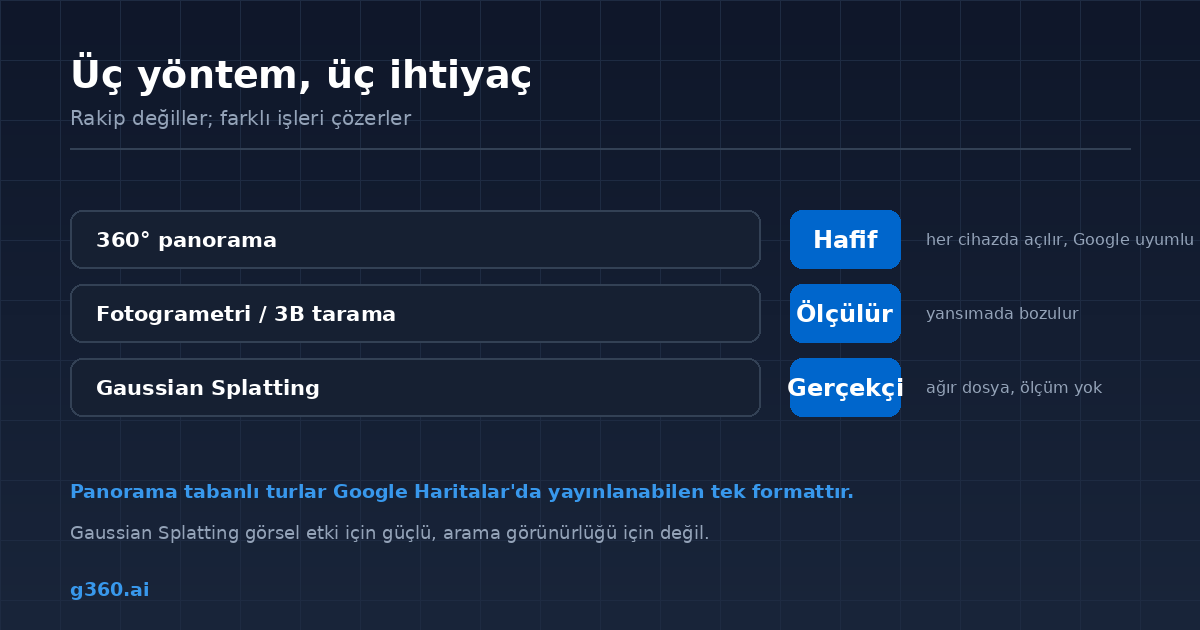
There are three approaches in use in the field today:
- 360° panorama: full spherical photos are taken from specific points, and the points are linked together. It's lightweight, fast and opens on any device. This is the foundation of virtual tours.
- Photogrammetry / 3D scanning: a solid model is built from a large number of photos. You can take measurements, but it breaks down on reflective surfaces.
- Gaussian Splatting: appearance is represented instead of surfaces. Visual realism is high, but the files are heavy and it isn't meant for measurement.
These three aren't competitors; each one answers a different need.
Why hasn't it caught on yet?
The demos are impressive, but there are concrete reasons it hasn't moved into widespread use:
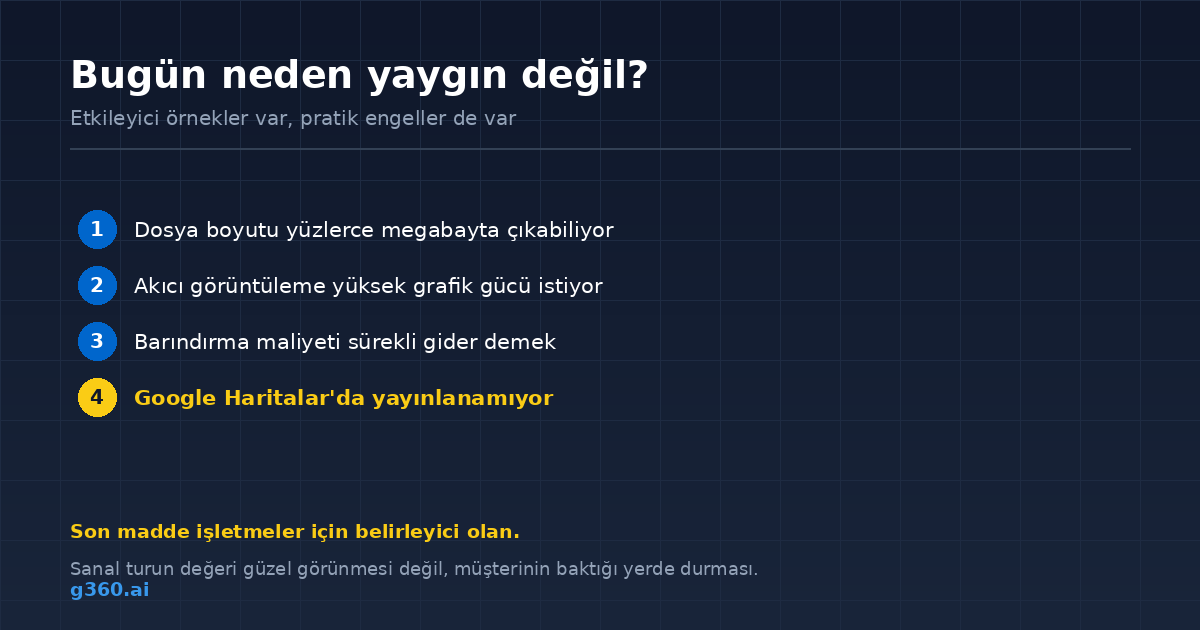
- File size. A single scene can reach hundreds of megabytes. A tour based on 360° panoramas is much lighter.
- Device power. Smooth viewing requires serious graphics processing power. The experience suffers on mid-range phones.
- Hosting cost. Heavy files mean constant bandwidth.
- No Google integration. This is the most critical point: the "See Inside" feature on Google Maps works with Street View-compatible panoramas. Gaussian Splatting scenes aren't part of that pipeline.
The last point is decisive for businesses. The real value of a virtual tour isn't that it looks good, but that it sits right where the customer is already looking.
Where things stand for businesses today
When a business gets a virtual tour, it wants three things: customers should see it, it should open fast and it should keep working for a long time.
In its current form, Gaussian Splatting falls behind panoramas on all three:
- Visibility: it can't be published on Google Maps
- Speed: it's heavy on mobile
- Longevity: hosting costs mean an ongoing expense
All of the 1,600+ tours in our archive were produced with a Street View-compatible panorama workflow and are live on Google Maps. The reason isn't technological conservatism; this workflow is the only one that meets a business's needs today.
Where can it be useful?
There are places where Gaussian Splatting is genuinely strong:
- Architectural presentations and project showcases
- Documenting museums, exhibitions and cultural heritage
- Product visualization and advertising production
- Capturing reflective, complex surfaces
What these have in common: visual impact comes first, search visibility second.
Will it replace virtual tours?
Not in the short term. In the long term, the answer depends on one thing: whether Google will support this format. If it does, and the file size problem is solved, the picture could change.
We're following the technology, and we'll evaluate it once it becomes practical for businesses. But telling a business today "let's do Gaussian Splatting instead of a virtual tour" would mean reducing its visibility, and we won't do that.
We explain the method that works today in our what is a 360-degree virtual tour guide, and the shoot process in our how to get a virtual tour made article.
Frequently Asked Questions
It is a 3D visualization method that represents a scene with millions of tiny, translucent points instead of a triangle mesh. Together, these points form a realistic image.
Photogrammetry builds a solid surface model from photos. Gaussian Splatting doesn't extract a surface; it represents light and appearance directly, which is why it handles reflections and transparency better.
Not for now. The biggest advantages of a virtual tour are its Google Maps integration and fast loading on every device, and Gaussian Splatting still lags behind on both.
There are examples for presentations and promotion, but file size, browser support and hosting costs currently limit widespread use.
It can, but depending on the size of the scene it requires a lot of processing power and data. Tours based on 360° panoramas are noticeably faster on mobile.
Not the same, but they're related. Both create realistic 3D scenes from images; Gaussian Splatting is usually faster to process and smoother to view.
No. The See Inside feature on Google Maps works with Street View-compatible panoramas, and Gaussian Splatting scenes aren't part of that pipeline.
Our production workflow is based on shooting Street View-compatible 360° panoramas. We're following Gaussian Splatting and will evaluate it once it becomes practical for businesses.
A Professional Virtual Tour for Your Business
Give your customers an unforgettable experience with a 360° virtual tour.
Get a Free Quote