Lighting for 360° Photography: Showing a Space as It Really Is
You cannot add extra light in a 360° shoot because there is no direction for it to come from. What remains is making the right use of the space's own light. A guide to choosing the time of day and preparing your venue.
Use the buttons below to get an AI summary of this article.
Lighting for 360° Photography: Showing a Space as It Really Is
In photography, light is controlled with flashes, softboxes, and reflectors. In 360° photography, none of these can be used.
The reason is simple and absolute: the scene looks in every direction. Any light source you place ends up in the frame. That leaves only one option: making the right use of the space's own light. This is why lighting in 360° photography is a planning issue, not an equipment issue.
Why extra lighting is not used
In a normal shoot, the light source sits outside the frame. In a 360° scene, there is no such thing as outside the frame.
A softbox placed behind the tripod shows up in the scene exactly as it is. A flash bounced off the ceiling leaves a bright spot on the ceiling. A light hidden in a corner makes that corner look brighter than it really is.
In theory, a light source can be removed from the image afterwards, but that means rebuilding the whole area, a much bigger version of the work done on the tripod mark at the nadir. In practice, it is not done.
The bottom line: in 360° photography, light is not added; the existing light is managed.
How to prepare the space's own light
Most of the preparation before a shoot is about light. Here is the checklist we repeat on site:
- All lighting is switched on. That includes window display lights, display spotlights, and decorative lighting. Businesses often keep some lights off to save electricity, and a tour shot in a half-lit space looks darker than the real venue.
- Burnt-out bulbs are checked. If one bulb in a row of spotlights is out, that area stays noticeably dark and stands out.
- Curtains are set the same way. Some curtains open and some closed creates uneven light across the scene.
- Temporary items that cast shadows are removed. A cardboard box in front of the door leaves a mark not only in the image but in the spread of light as well.
This preparation is the business's job and needs to be done before the shoot day. Changing bulbs once the team arrives wastes time.
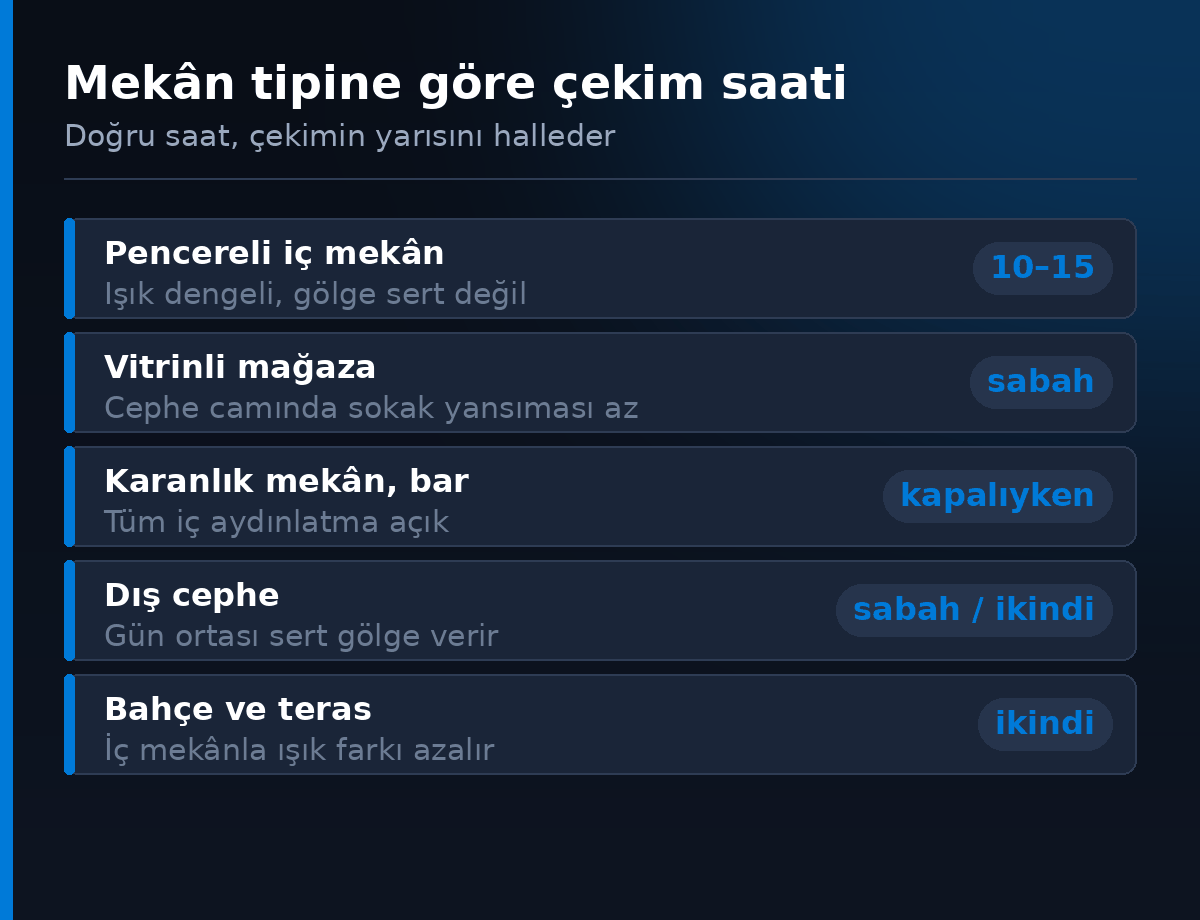
Shooting time by venue type
Choosing the time of day is the most powerful lighting tool you have. Pick the right time and half the work takes care of itself.
The logic behind the table is this: the smaller the light difference between indoors and outdoors, the easier the shoot. At midday, it is very bright outside and relatively dark inside. HDR closes that gap, but the bigger the gap, the more artificial the result looks.
The exterior follows the opposite logic. Midday sun creates harsh shadows and high contrast, while in the morning and late afternoon the light is soft and the shadows are long but not harsh. We cover this in detail in our outdoor 360 photography guide.
The mixed color temperature problem
This is the most technical side of lighting, and most business owners never think about it.
Light sources have different colors: daylight from a window leans blue, incandescent bulbs are yellow, white LEDs are neutral, and fluorescent light drifts slightly green. The eye compensates for this, so a white sheet of paper looks white under any light. A camera does not.
A single 360° scene can contain all three kinds of source at once. When automatic white balance picks an average value, no area comes out right: the window edge turns blue and the area under the ceiling turns yellow.
The fix happens during processing, by correcting white balance scene by scene. Applying a single setting to the whole tour does not work in these conditions. This becomes critical in industries such as florists, where color directly drives the buying decision.
What to do in spaces with windows
Windows are the hardest part of shooting an interior. There are a few practical approaches.
Sheer curtains are closed if there are any. Sheers cut the brightness from outside while still letting light through. If the view does not matter, this is the most practical solution.
If the view matters, more HDR brackets are used. Leaving the window blown out white in a sea-view hotel room is not acceptable, so more exposure brackets are taken and the shoot takes longer.
The team waits out the hours of direct sun. If the sun shines straight through the glass, the bright patches on the floor cannot be fixed even with HDR. The solution is to wait for the hour when that side of the building is out of the sun.
The scene point does not turn its back on the window. Setting the tripod to the side instead of directly facing the window moves the contrast to the edge of the frame.
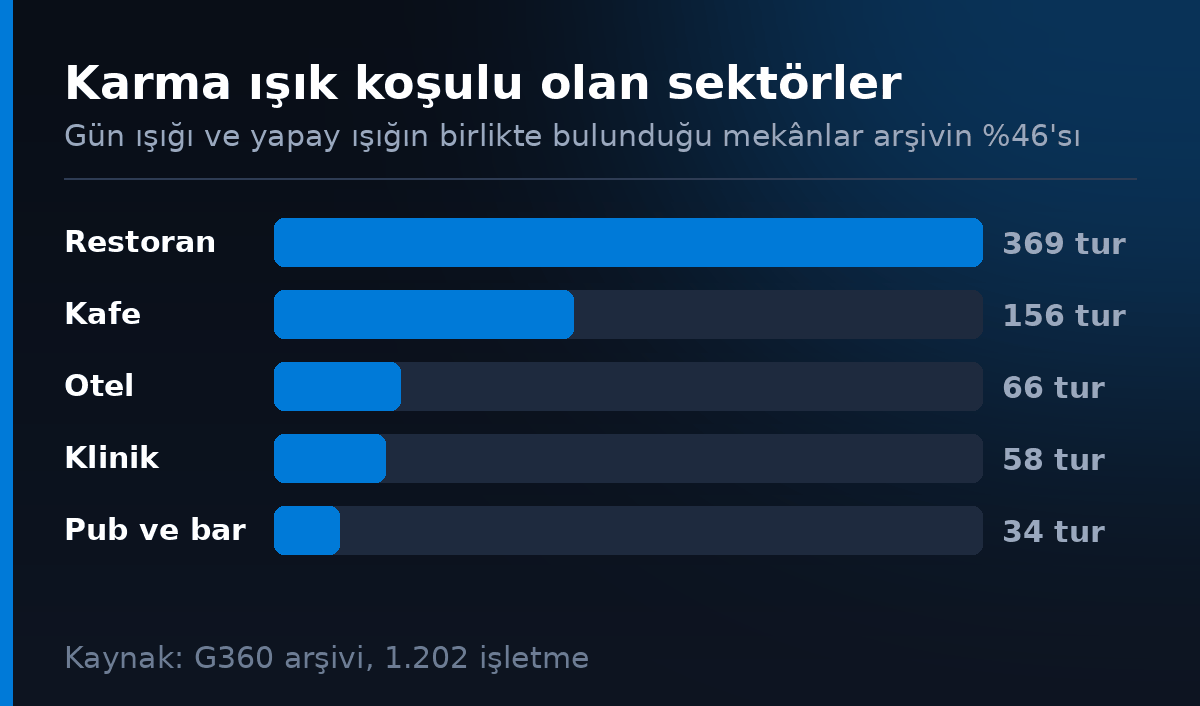
From our archive: industries with mixed lighting
Spaces where daylight and artificial light come together are the group that takes the most work when it comes to lighting.
When we sorted the 1,600+ businesses in the G360 archive this way, restaurants, cafes, hotels, clinics, and pubs added up to 873 projects, more than half of the archive. What these venues have in common is large glass facades or windows combined with heavy artificial lighting.
By contrast, warehouses, workshops, and windowless retail spaces have a much simpler lighting setup. A single exposure and a single white balance setting are usually enough there.
So "lighting difficulty" has to do with the variety of light sources, not the size of the space. The full archive breakdown is in our data report.
Pre-shoot lighting checklist
These are checks business owners can do before the shoot day that directly affect the result:
- Are all bulbs working, or are any burnt out?
- Are there bulbs of different colors in the same space? (one spotlight yellow, another white)
- Can the window display and display lighting be switched on?
- Can the curtains all be set the same way?
- Have the glass surfaces been cleaned? (dirty glass scatters light)
- Does direct sun come into the space at the time of the shoot?
Going over this list the day before the shoot cuts the time spent on site and makes the result noticeably better.
Summary
In 360° photography, light cannot be added; it can only be managed. That is why lighting is a matter of planning and preparation, not equipment.
Three things are decisive: having all the lighting switched on, choosing the shooting time based on the type of venue, and correcting mixed color temperature scene by scene during processing.
For general preparation on the shoot day, see our guide on how to get a virtual tour made.
Frequently Asked Questions
Because the scene looks in every direction, there is no such thing as outside the frame. Any light source you place shows up in the image, and a flash bounced off the ceiling leaves a bright spot. So no light is added; the space's existing light is managed instead.
It depends on the type of venue. Interiors with windows are best shot between 10:00 and 15:00, stores with window displays in the morning, and dark venues while the business is closed with all the lights on. For the exterior, morning or late afternoon is preferred over midday.
Daylight leans blue, incandescent bulbs are yellow, and fluorescent light drifts slightly green. These sources can all appear in the same 360° scene. When automatic white balance picks an average value, no area comes out right; the fix is correcting each scene individually.
Turn on all the lights, replace any burnt-out bulbs, avoid bulbs of different colors in the same space, set all the curtains the same way, clean the glass surfaces, and check whether direct sun comes into the space at the time of the shoot.
Sheer curtains are closed if there are any. If the view matters, more HDR brackets are used. Hours of direct sun are avoided, and the tripod is placed to the side rather than directly facing the window, which moves the contrast to the edge of the frame.
It can, but the result makes the space look darker than it really is. Businesses often keep some lights off to save energy; during the shoot, all lighting needs to be on, including window display lights and display spotlights.
The difficulty depends on the variety of light sources, not the size of the space. Restaurants, cafes, hotels, clinics, and pubs, where large glass facades sit alongside heavy artificial lighting, are the group that takes the most work.
Yes. Dirty or smudged glass scatters incoming light, lowers contrast, and makes reflections stand out. Cleaning all glass surfaces before the shoot visibly improves the result.
A Professional Virtual Tour for Your Business
Give your customers an unforgettable experience with a 360° virtual tour.
Get a Free Quote