Virtual Tour Guide for Car Dealerships and Auto Service Centers
How do you handle reflections on showroom glass, should you shoot the service area, and how do you plan tours for a dealership chain? A practical guide from 40 automotive projects.

Use the buttons below to get an AI summary of this article.
Virtual Tour Guide for Car Dealerships and Auto Service Centers
Before visiting a dealership, a car buyer usually rules out a few places. Most of that filtering happens on screen, and the deciding factor is not the car, since the car is already listed on a classifieds site. What gets filtered out is the business itself: how big is the showroom, how many cars are there, does a service center really exist, is this a small lot or a professional facility?
A photo cannot answer any of these questions, because you cannot see what is outside the frame. In a virtual tour, visitors look around based on the question in their own head: one checks the service reception, another the size of the showroom, another the customer waiting area. That is why virtual tours work in the automotive industry: not because they deliver information, but because they remove doubt.
Showroom, service center, or both
There are three types of automotive businesses, and each one is shot differently.
Showroom only. A business that sells used or new cars and has no service department. Here the tour is short and dense: the showroom floor, the vehicle line, the sales desk. On average, 8–10 scenes.
Showroom + service. The most common setup. The service area is the most valuable part of the tour, because it is the section customers wonder about most but see least.
Service only or auto parts and repair. What is being sold here is not a car but trust. The organization of the workshop, the equipment, and the cleanliness are direct decision signals.
Whichever type you are, the exterior is shot on every project; this is not a choice but a technical requirement. For the tour to connect with the street-level imagery on Google Maps, the entrance point has to be captured.
The real challenge in showroom shoots: reflections
Along with furniture showrooms, automotive is one of the two industries where reflections are hardest to manage. Three surfaces act like mirrors at the same time: car paint, the storefront glass, and the polished floor.
Three rules work in the field.
Set up the tripod along the walkway, not between the cars. In a scene shot right next to a car, the entire body panel reflects the equipment. Stepping back one meter moves the reflection off the painted surface.
Do not face the storefront glass head-on. A scene looking at the glass at 90 degrees brings the street outside and the building across the road into the showroom. Shifting the angle by 20–30 degrees largely solves the problem.
Have all ceiling lights turned on before the shoot. In car showrooms, spotlights usually work in zones and some are kept off. A tour shot in a half-lit showroom looks darker than the real space.
How many scenes do you need?
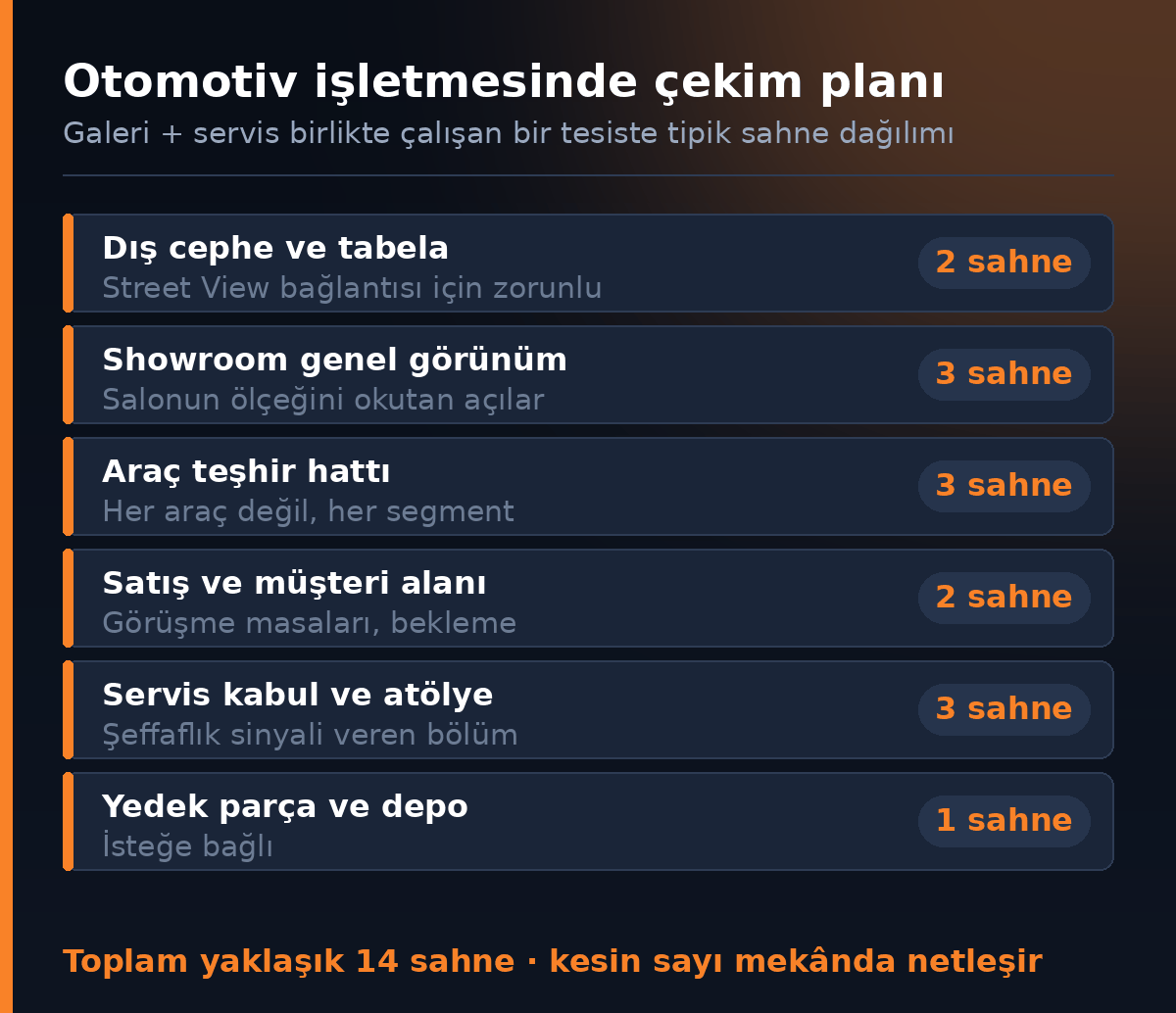
A scene is a single 360° image captured from one tripod position in the space. In automotive, the number of scenes is set not by square meters but by the number of separate areas, which is also the basic logic behind virtual tour pricing.
In a mid-sized facility where the showroom and service center operate together, the typical layout is as shown above: around 14 scenes in total. For a showroom only, 8–10 scenes are enough; for a service center only, 6–8.
One point to watch: do not make every car a separate scene. Just as a hotel shoot covers each room type rather than every room, a dealership shows each segment rather than every car. The goal is not to build an inventory but to show what the showroom offers. The inventory changes every three days anyway, while the tour stays in place for years.
Is it risky to shoot the service area?
This is the most common objection: "The workshop looks messy, should we skip it?"
What we see in the field says the opposite. An automotive tour that does not show the service area leaves customers wondering whether a service center really exists. A workshop that looks a bit busy is not a drawback but a signal; a sterile service photo does not convince anyone anyway.
Here is what to do:
- Before the shoot, have scrap parts, empty boxes, and rags cleared from the floor; group equipment that cannot be moved in one spot
- Do not lower the car on the lift; leave it there, because the look of a working workshop is valuable
- Avoid angles where customer license plates can be read
- If you do not want staff in the frame, schedule the shoot during a break
Preparing for shoot day
In automotive, preparation determines the quality of the shoot more than in many other industries.
- Have the glass and bodywork of display cars wiped before the shoot; dust is far more visible in a 360° image than in a photo
- Place price tags and promotional cards neatly and straighten any that are crooked
- Move staff cars parked on the showroom floor outside
- Clear the service reception desk; piles of paperwork are the detail that stands out most
- Keep the sign and exterior lights on during the exterior shoot
From our archive: 40 automotive projects
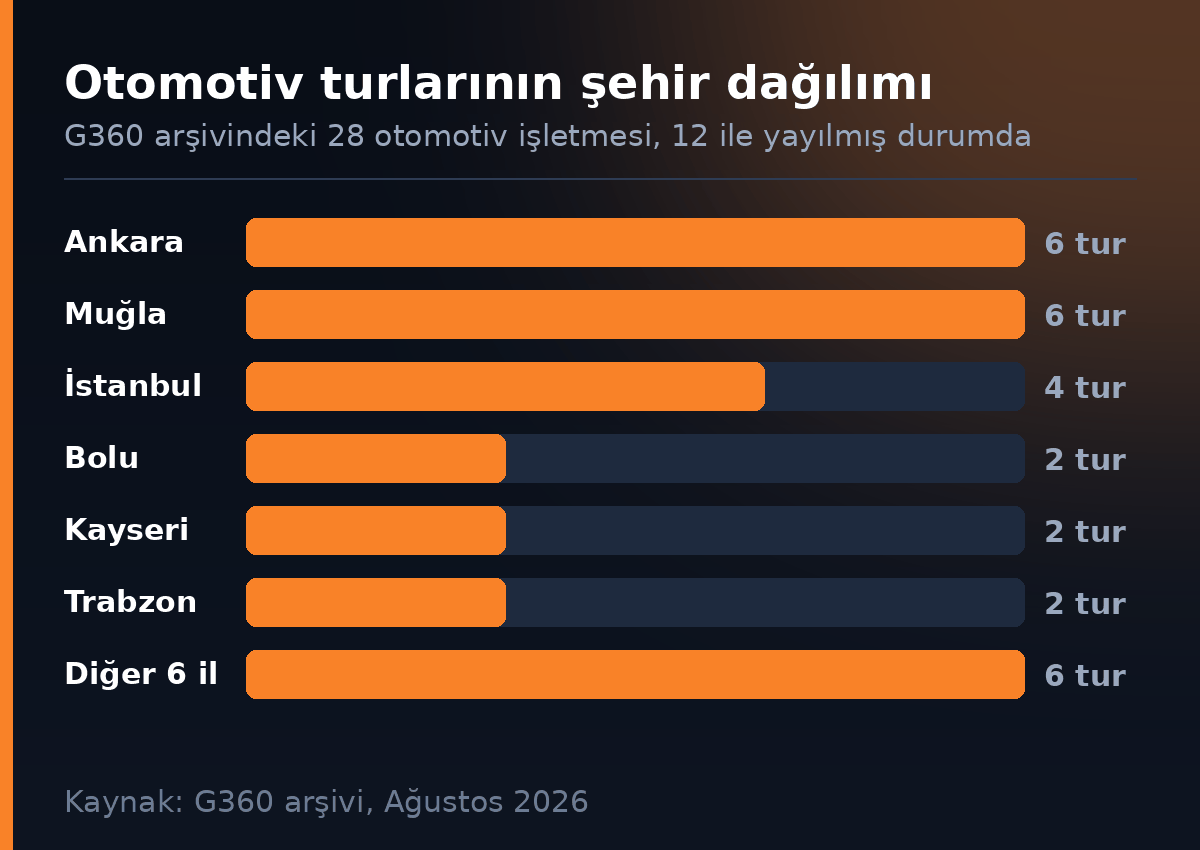
The G360 archive holds virtual tours of 40 automotive businesses across Turkey. These tours are spread across 17 provinces and 27 districts; the busiest provinces are Ankara and Muğla (seven businesses each), followed by Istanbul (four businesses).
The average Google rating of these businesses is 4.44, above the archive-wide average of 4.28. The median review count is 66, which means automotive is not a high-review-volume industry like restaurants or hotels. The total review count is 12,109.
This number needs to be read correctly: in automotive, customers rarely leave reviews because they buy infrequently. That also means there are fewer signals to look at when making a decision. This is one reason virtual tours carry more weight in this industry: the space itself fills the gap that review counts cannot.
You can explore the breakdown across all industries in our Turkey data report and see completed automotive projects in our automotive portfolio.
How to plan tours for dealership chains
For authorized dealers with multiple locations, the most common mistake is having each location shot at different times with different approaches. The result: one location looks bright, another dark, one has 6 scenes and another 15, and brand consistency breaks down.
The right way is to set a single scene template for all locations: exterior 2, showroom 3, display 3, sales 2, service 3. Depending on the size of the location, this varies by ±2 scenes, but the framework stays the same. That way, customers see the same structure no matter which location they look at.
Because each location has its own Google Business Profile, the tours are also connected separately; they are not combined under one central profile.
Where to start
In automotive, a virtual tour does not replace the listing; it completes it. Someone who sees a car on a classifieds site searches for the business on Google, and what they see there shapes the decision.
If you want to know how many scenes your business needs, you can use the calculator on our pricing page and read how the process works in our guide on how to get a virtual tour.
Frequently Asked Questions
A showroom only needs 8–10 scenes, a showroom with a service center around 14 scenes, and a service center or auto repair shop alone 6–8 scenes. These numbers include the 2 exterior scenes shot on every project. The exact number is confirmed on site and given as a range with a margin of about 10%.
No. Just as a hotel shoot covers each room type rather than every room, a dealership tour shows each segment rather than every car. The goal is to show what the showroom offers, not to build an inventory. The car inventory changes constantly, while the virtual tour stays in place for years.
You do not have to, but it is recommended. An automotive tour without the service area leaves customers asking whether a service center really exists. A workshop that looks busy is not a negative but a reassuring signal.
It is a manageable problem. The tripod is set up along the walkway rather than between cars, the storefront glass is never faced head-on, and the ceiling lights stay fully on throughout the shoot. These three rules remove most reflections.
Wipe the glass and bodywork of display cars, straighten price tags, move staff cars out of the showroom, clear the service reception desk, and turn on all showroom lights. Dust and scattered paperwork stand out far more in a 360° image than in a photo.
Yes. Because each location has its own Google Business Profile, tours are shot and connected separately. However, a single scene template should be set for all locations; otherwise, large differences in quality and scope appear between them.
When planning the shoot, angles where customer license plates can be read are avoided. This gets special attention in the service area. If needed, the affected scenes are reshot from a different position.
The 40 automotive businesses in the G360 archive have an average Google rating of 4.44, compared with 4.28 across the whole archive. The median review count is 66. This does not show cause and effect; it reflects the businesses' overall Google performance.
A Professional Virtual Tour for Your Business
Give your customers an unforgettable experience with a 360° virtual tour.
Get a Free Quote