Virtual Tours for Landmarks and Historic Buildings
Permits, crowd management, and timing for monuments, museums, and high-traffic venues. A guide drawn from the 11 projects with the highest review volume in our archive.

Use the buttons below to get an AI summary of this article.
Virtual Tours for Landmarks and Historic Buildings
Monuments, museums, and high-traffic venues work very differently from a standard business shoot. The process starts with permits and is planned weeks in advance.
What counts as a special project
The G360 archive covers 25 industries, and one of them is unlike the others: special projects. Monuments, museums, shopping malls, and facilities with very high visitor traffic.
What sets this group apart is not scale but the way the work is done. Shooting a cafe takes one morning; shooting a monument requires a permit process that starts weeks in advance, a shoot day planned hour by hour, and often a second visit.
This article was written so that, if you are responsible for a corporate or public venue, you can see the whole process from the start. If you are curious about how a standard business shoot works, our guide on how to get a virtual tour is a better fit.
Permits start weeks before the shoot
In special projects, the first and longest stage is getting permission. In a commercial business, one person makes the decision; in public or corporate venues, several authorities get involved:
- The institution or foundation that manages the venue
- The heritage conservation board (for listed buildings)
- Building management (in malls and mixed-use buildings)
- The security department (for shooting equipment and hours)
In concrete terms, this means that before a shoot date is set, it must be confirmed in writing which areas can be shot, whether a tripod is allowed, and during which hours the team can work. An area that turns out to be off-limits later ruins the whole scene plan.
Ask about tripod permission separately. In some museums and historic buildings, taking photos is allowed, but using a tripod needs separate permission. Since 360° shoots cannot be done without a tripod, this is a critical item.
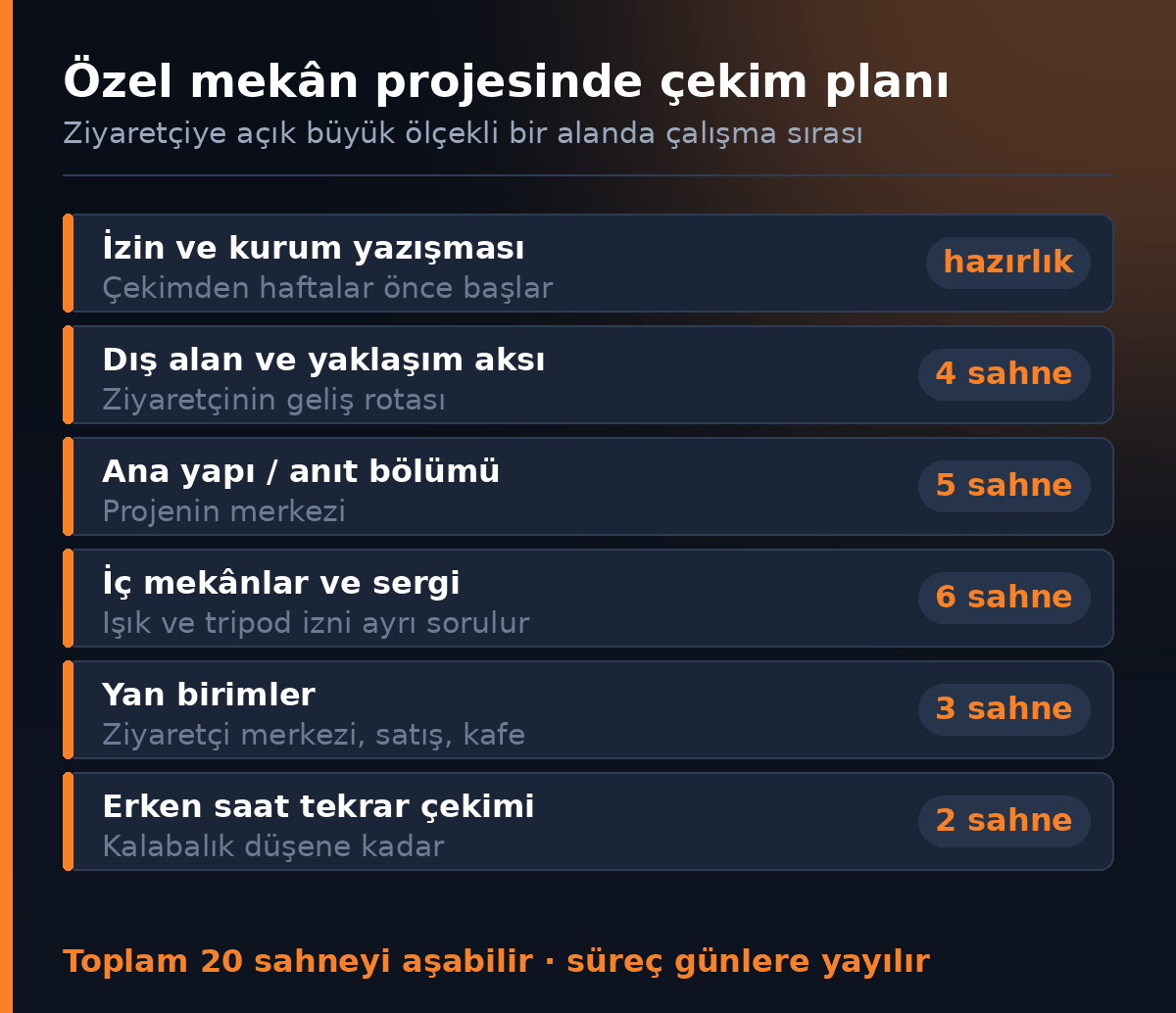
How many scenes do you need?
In special projects, the number of scenes cannot be calculated with standard tables. The plan above shows the working order for a large venue open to visitors: it easily goes past 20 scenes in total, and the process stretches over more than one day.
Three things are decisive:
- The approach route. An unbroken series of scenes is needed along the route visitors take to arrive; otherwise, the tour ends up disconnected on the map.
- The number of indoor areas and their permit status. Each exhibition hall is planned separately.
- A margin for reshoots. It is factored in from the start that some scenes will need to be shot a second time because of crowds.
We explain how prices are calculated for standard businesses in our scene-based pricing guide; special projects, by contrast, are priced on a per-project basis.
Crowds: not unsolvable, just something to plan for
In a venue open to visitors, there is never a moment when no one is around. Waiting does not work; planning does.
Three methods work in the field.
Early hours. The first hour before or just after opening is when visitor traffic is lowest. Most projects are shot during this window.
Closed days. A museum's weekly closed day is ideal, but since maintenance and cleaning happen on these days, extra coordination is needed.
Section by section. Instead of shooting the whole venue at once, start in the section where the visitor flow is not at that moment and move against the flow. This takes experience, but it is the most practical method.
None of these gives a completely empty result. A few visitors in the distance are acceptable; people standing close up in the middle of the frame mean the scene has to be reshot.
Outdoor areas and height
In historic buildings and large campuses, the outdoor areas are as important as the interior. The approach route, courtyards, garden layout, and angles that show the building as a whole form the backbone of the tour.
The rules of outdoor 360 photography apply here: midday light gives harsh shadows, so morning and late afternoon are preferred. Drones, on the other hand, are often not an option in special projects: most historic sites are in no-fly zones and require separate permission. This should not be assumed from the start when planning the shoot.
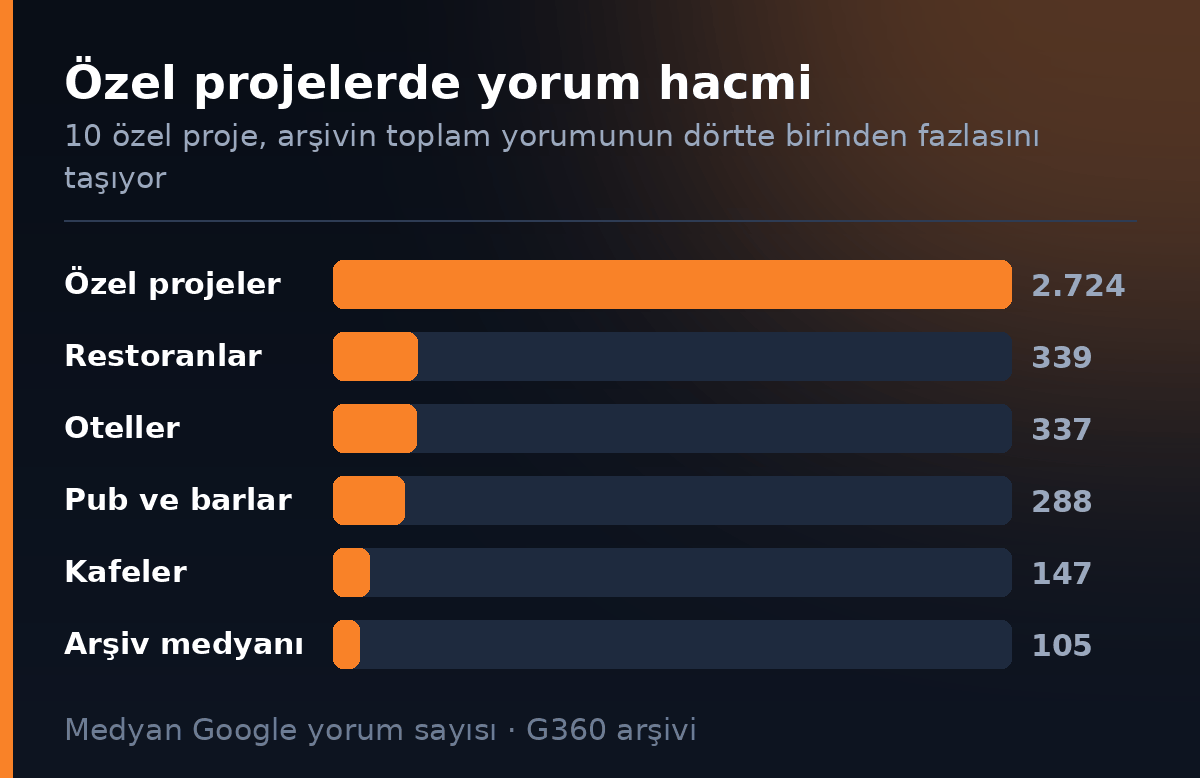
From our archive: 11 special projects
The G360 archive includes 11 special projects, spread across 6 provinces and 7 districts. The busiest provinces are Trabzon and Kocaeli (three projects each), followed by Ankara (two projects).
The number is small, but the scale is large. These 11 projects carry a total of 221,167 reviews on Google Maps, more than one fifth of the 1,077,330 total reviews across the 1,600+ businesses in the archive. The median review count is 1,459; compared with the archive median of 114, that is roughly 13 times higher.
The average Google rating of this group is 4.31, almost equal to the archive-wide average (4.28). In other words, visitor traffic does not push the rating up; it only increases visibility and data volume.
The full archive is published in our Turkey data report, where you can explore it.
What to expect from these projects
In special projects, it is important to set the right expectations from the start.
Reasonable to expect: the venue becomes explorable online, remote access opens up, there are concrete benefits for corporate and educational use, and a permanent digital record exists on Google Maps.
Not to be expected: a direct increase in visitor numbers. For a venue that is already well known, the job of a virtual tour is access, not promotion. Projects that do not make this distinction end up unhappy with the results.
There is one more point: special projects last a long time. As long as the venue does not change, the tour can stay in place for ten years and gain documentary value over time. The meaning a tour shot before a restoration carries later on cannot be foreseen at the time of the shoot.
How the process starts
If you are considering a shoot for a corporate or public venue, here is how the process works: first a discussion of the venue and scope, then identifying permit requirements, then planning the hours and sections, and finally the shoot and delivery.
For the first step, you can reach us through our contact page and browse similar work in our portfolio.
Frequently Asked Questions
The institution or foundation that manages the venue, the heritage conservation board for listed buildings, building management for mixed-use buildings, and the security department get involved. Which areas can be shot, whether a tripod is allowed, and the working hours must be confirmed in writing before the shoot date.
Yes, it is an item to ask about separately. In some museums and historic buildings, taking photos is allowed, but using a tripod needs separate permission. Since a 360° shoot cannot be done without a tripod, this is a critical point.
Three methods are used: shooting in the early hour before or just after opening, working on the museum's weekly closed day, or moving section by section against the visitor flow. A few visitors in the distance are acceptable; people close up in the middle of the frame mean the scene must be reshot.
It cannot be calculated with standard tables. In a large venue open to visitors, the total easily goes past 20 scenes, and the process stretches over more than one day. The approach route, the number of indoor areas, and a margin for reshoots are decisive.
Often not. Most historic sites are in no-fly zones and require separate permission. For that reason, drone shots should not be assumed from the start when planning.
The permit process starts weeks in advance. Fieldwork usually stretches over more than one day, and some sections are shot a second time because of crowds. Considering that a standard business shoot is done in one morning, the process works completely differently.
For a venue that is already well known, the job of a virtual tour is access, not promotion. You can expect the venue to become explorable online and to be used remotely and for education; expecting a direct rise in visitor numbers is not realistic.
The 11 special projects in the G360 archive carry a total of 221,167 Google reviews, with a median of 1,459. The archive median is 114. This is a natural result of visitor traffic. Even so, their average Google rating of 4.31 is almost equal to the archive-wide average.
A Professional Virtual Tour for Your Business
Give your customers an unforgettable experience with a 360° virtual tour.
Get a Free Quote