Virtual Tours for Clothing Stores: Building Trust Where Reviews Are Few
The median review count for clothing stores is 29, so customers decide based on another signal. A guide to shop windows, sections, and fitting rooms from 21 store shoots.

Use the buttons below to get an AI summary of this article.
Virtual Tours for Clothing Stores: Building Trust Where Reviews Are Few
Clothing is one of the retail categories with the fewest Google reviews. When customers cannot find a signal to base their decision on, the store itself steps in.
The signal problem in clothing retail
Retail has an odd quirk: clothing is one of the industries where customers leave the fewest reviews. Across the 21 clothing stores in the G360 archive, the median Google review count is 29. For comparison: 420 for restaurants and 142 for cafes.
The reason is simple. People write reviews for a meal they ate, not for a T-shirt they bought. Unless they had a bad experience, they do not come back to leave a star rating.
The result: when customers find a clothing store on Google, they cannot find enough signals to make a decision. They cannot choose between a store with 12 reviews and one with 14. What fills that gap is being able to actually see the store, and that is the real job of a virtual tour in this industry.
What customers look at
These are the questions that come up again and again in the field:
- Product density. Are the racks full, is there choice, or is it a half-empty store?
- Segment. Does this place fit my style and budget? Customers read this from the store layout and displays.
- Scale. Is it a small boutique or a store big enough to browse?
- Fitting rooms and service. Are there fitting rooms, how many, are alterations offered?
Notice that none of these are about individual products. The products are already online; what is missing is the store itself. In this respect, clothing works much like the general logic of store shoots, but the shop window and fitting rooms bring their own rules.
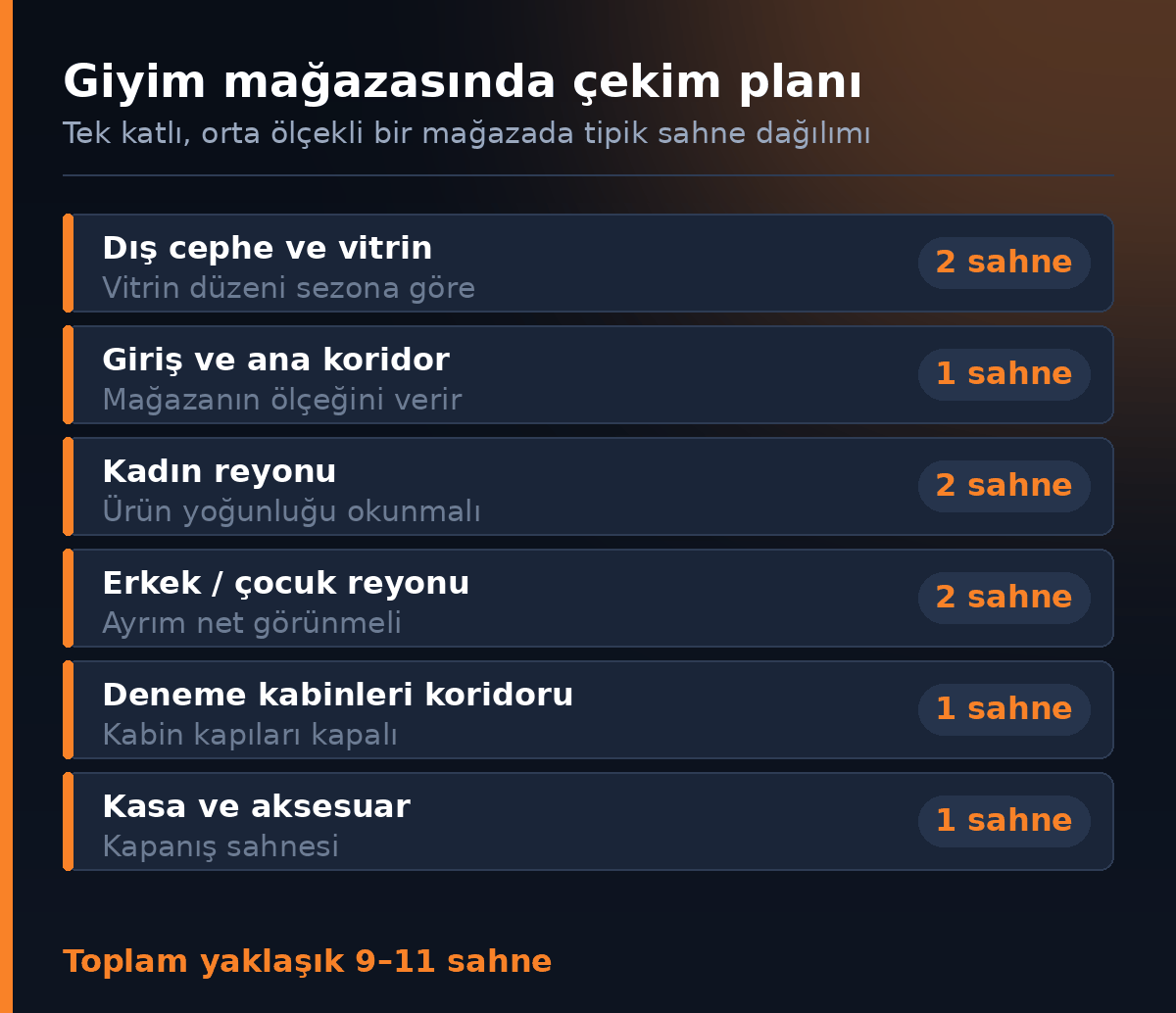
How many scenes do you need?
A scene is a single 360° image captured from one tripod position in the space. In clothing retail, the number of scenes depends on how the sections are divided and how many floors there are.
In a mid-sized, single-floor store, the typical layout is as shown above: 9–11 scenes. A small boutique can be done in 6–7 scenes. A two-floor store with many sections can reach 15 scenes.
In stores with crowded rack layouts, the shooting points need to be closer together; otherwise, visitors lose the connection between two scenes. We explain how the number of scenes affects the price in our pricing guide.
The shop window: the single most important scene in the tour
In clothing retail, the exterior scene is more critical than in other industries, because the shop window is the store's identity card. Customers read the store's segment largely from the window.
What we pay attention to in practice:
- The shop window is shot during the day, in natural light, but the window lighting stays on too; in daylight alone, the window looks dull
- To reduce glass reflections, the tripod is set at an angle rather than facing the glass head-on
- No shoots during season changes: a window that is half sale and half new season shortens the life of the tour
- If baskets or stands are set out on the sidewalk, they are tidied, not removed; the real view is more convincing
The exterior shoot is also a technical requirement: for the tour to connect with the street-level imagery on Google Maps, the entrance point has to be captured.
How fitting rooms are shot
The fitting rooms are shot, but not their interiors. The right approach:
- The fitting room corridor is shot as one scene, so the number and width of the rooms are visible
- All fitting room curtains or doors are closed
- No separate scene is made inside a fitting room; it is both unnecessary and a privacy concern
- Mirrors cause tripod reflections; these are kept to a minimum by placing the shooting point at an angle to the mirror
Skipping the fitting room section entirely is also an option, but it is not recommended: "Is there a fitting room, and is it cramped?" is a question customers genuinely ask.
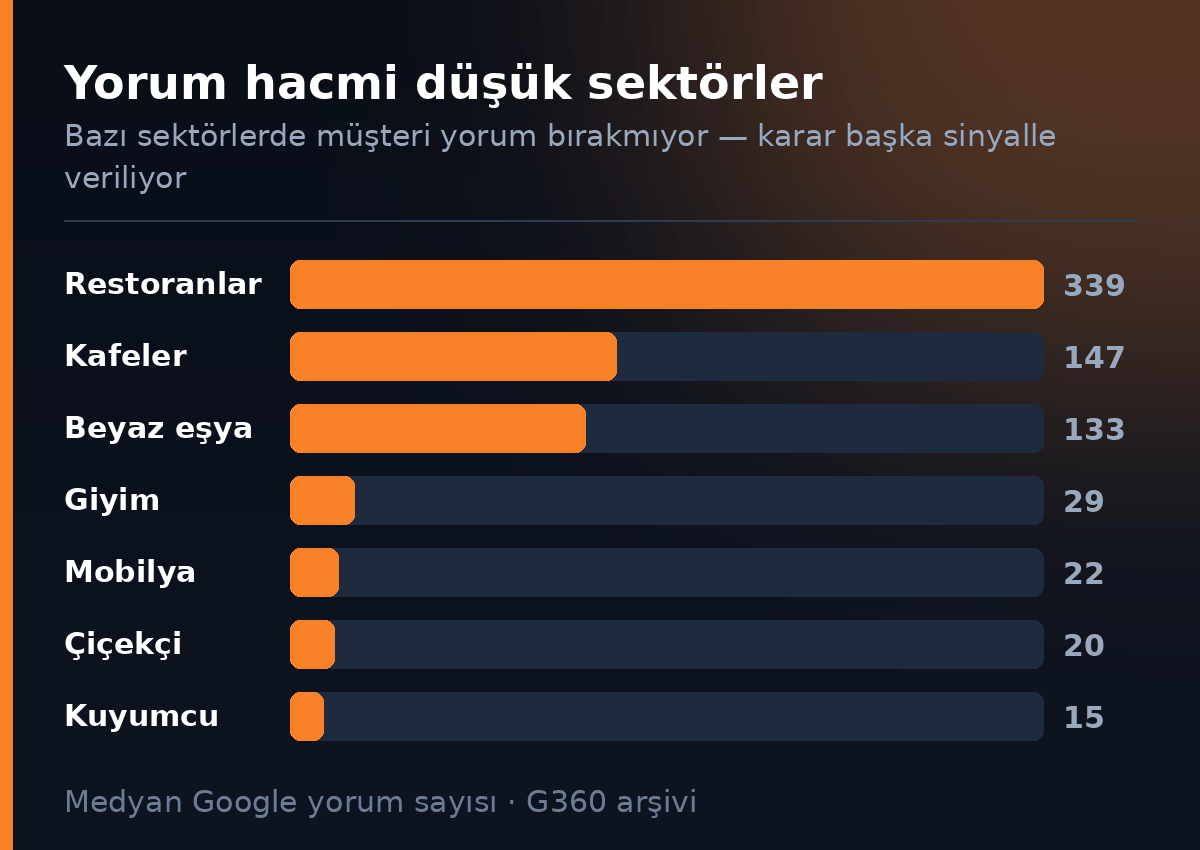
From our archive: 21 clothing stores
The G360 archive holds virtual tours of 21 clothing stores, spread across 12 provinces and 18 districts. The distribution is quite balanced: the busiest province is Istanbul (four stores), followed by Ankara (three stores) and Muğla (two stores). In other words, tours in this industry are not concentrated in a few big cities.
The average Google rating of these stores is 4.21, slightly below the archive-wide average (4.28). The median review count is 29, with 2,574 reviews in total.
This picture confirms the point made at the start: in clothing retail, reviews are few and the average rating is ordinary. It is hard for customers to find a distinguishing signal. The same is true for jewelry stores (median 15), furniture (22), and florists (17), all retail categories with low review frequency.
This is not a claim of cause and effect; it simply shows that where reviews cannot settle a decision, the visibility of the space does more of the work.
The full industry breakdown is in our data report, and completed projects are in our clothing portfolio.
Extending the life of the tour
The most common objection in clothing retail: "Won't the tour become outdated when the collection changes?"
Partly. But what the tour shows is the store, not the collection. The wall layout, section arrangement, fitting rooms, checkout, and scale stay the same for years. Changing products on the racks does not make the tour invalid.
Still, two things help extend its life:
- Shoot timing. Shoot mid-season, when the store is fully set up. Sale periods and season changes are avoided.
- Avoiding heavy promotional graphics. A tour full of "70% off" posters becomes a dated image six months later.
If there is a major renovation or a move, the tour is refreshed; otherwise, it stays in place for years.
Connecting the tour to sales
If the tour only sits on Google Maps, part of its potential goes unused. Uses that work in clothing retail:
- Add it to your Instagram profile link, so people coming from social media can browse the store before deciding to visit
- If you have a website, embed it on the contact or store locations page
- Keep a QR code at the checkout to make it easy for customers to share the tour
You can calculate how many scenes your store needs with the tool on our pricing page.
Frequently Asked Questions
A mid-sized, single-floor store needs 9–11 scenes. A small boutique can be done in 6–7 scenes. Two-floor stores with many sections can reach 15 scenes. These numbers include the exterior scenes shot on every project.
No. The fitting room corridor is shot as one scene, so the number and width of the rooms are visible, but all doors or curtains are kept closed. No separate scene is made inside a fitting room; it is both unnecessary and a privacy concern.
The tour shows the store, not the collection. The wall layout, section arrangement, fitting rooms, checkout, and scale stay the same for years. Changing products on the racks does not make the tour invalid. A refresh is only needed after a major renovation or a change of address.
Mid-season, when the store is fully set up. Sale periods and season changes are avoided, because a window that is half sale and half new season shortens the life of the tour.
The shoot is done during the day in natural light, but the window lighting stays on as well. To reduce glass reflections, the tripod is set at an angle rather than facing the glass head-on. Baskets and stands on the sidewalk are tidied, not removed.
People write reviews for a meal they ate, but usually not for clothes they bought. Across the 21 clothing stores in the G360 archive, the median review count is 29; for restaurants it is 420. This reduces the number of signals customers can look at when deciding.
Largely, yes. The difference is that sections are more densely divided, so shooting points are placed closer together. If there is a try-on area, it is shot using the fitting room corridor approach.
You can add it to your Instagram profile link, embed it on your website's store locations or contact page, and keep a QR code at the checkout. The embed code and QR codes are provided with delivery.
A Professional Virtual Tour for Your Business
Give your customers an unforgettable experience with a 360° virtual tour.
Get a Free Quote